





















Subnautica 2 Biomes









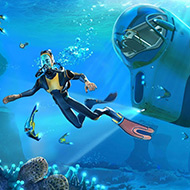
What happens when your oxygen gauge drops toward zero and the nearest air pocket is a three-minute swim through a biome you haven’t scanned yet? That moment of held-breath panic is the whole pitch of Subnautica 2 Biomes, repeated from the second your lifepod splashes down until the credits roll. There’s no popup telling you which way is safe; you just swim, and learn the ocean by nearly dying in it.
| Genre | Survival, Exploration, Open World |
| Platform(s) | PC, PlayStation, Xbox, Nintendo Switch |
| Player Mode | Single-player |
| Difficulty | Survival, Freedom, Creative, Hardcore |
Why Subnautica 2 Biomes’s Depth Progression Feels Like a Dare
The Safe Shallows are shallow, sunlit, and full of harmless Peepers darting around kelp stalks. It’s a gentle on-ramp, and also where beginners get comfortable in ways that hurt them later. New players tend to hoard Titanium and Copper without crafting a Seaglide or a second Oxygen Tank, then get caught off guard when a supply run into the Kelp Forest runs long and the air meter blinks red.
The game rarely announces that a zone got more dangerous; it shows you through sound and silhouette. Early in the game a Stalker patrolling the Kelp Forest is just a nuisance stealing scrap metal. By the time you reach the Grand Reef or the Mountains, visibility collapses and Reaper Leviathans patrol open sand flats with nowhere to hide. Depth becomes a locked door: your gear’s crush depth decides what’s survivable, not your skill.
Once the Mobile Vehicle Bay lets you fabricate a Seamoth, the map effectively doubles, and once the Cyclops appears in your blueprint list, the Lost River stops being a suicide mission and starts being a commute. Plenty of players find the early hunger-and-thirst micromanagement tedious, and honestly, it can be; the first in-game days are more chore than adventure until the tools catch up.
Oxygen, Hunger, and Thirst Beneath the Surface
The three survival meters never really go away, they just get easier to manage. Peepers and Bladderfish handle hunger early, Fins cut travel time enough that oxygen stops being a constant worry, and Marblemelon plants solve thirst for good. Players who avoid the deep biomes out of fear often lean into Alien Containment tanks instead, breeding fish in a shallow-water base so they never swim past the drop-off.
Base-Building and the Vehicles That Get You Home
Base construction in Subnautica 2 Biomes is modular: foundations, multipurpose rooms, hatches, and glass corridors snap together, and every piece contributes to hull integrity. Get the math wrong and a base springs a leak that hisses through your headset, the game’s way of telling you to grab the Repair Tool and stop panicking. Beginners often build their first base without checking depth, only to find it clips through rock or a Reaper claims the neighborhood as its territory.
Builders who min-max their base tend to turn it into a hybrid greenhouse and fish farm, lining walls with Alien Containment units and planter pots so they never leave for food again. A Bioreactor humming on Lava Lizard meat keeps the Fabricator running once the base sprawls past a few rooms. The scanner room, once unlocked, turns resource hunting into a passive minigame, pinging deposits you’d otherwise never find.
None of this is flawless. Base-building jank is real: windows refuse to snap where you want them, rooms generate phantom leak points, and moving a foundation later means demolishing half of what you built around it.
Cyclops, Seamoth, and Prawn Suit Trade-Offs
Three vehicles define how far you can push into Subnautica 2 Biomes’s depths, each gated by its own crush depth:
- Seamoth: fast and fragile, capped at 900 meters even fully upgraded, great for early exploration and useless once you’re chasing Precursor sites.
- Prawn Suit: trades speed for punches, a grappling arm, and drills, starting at 900 meters and reaching 1700 with both Depth Modules installed.
- Cyclops: the real commitment, a stock hull survives only to 500 meters, but a fully upgraded one reaches 1700, and its silent running and decoy tubes matter more than raw depth once a Leviathan takes interest, which is why speedrunners often skip it and beeline the Prawn Suit instead.
Reaper Leviathans and Other Sounds You Never Forget
Ask anyone who’s played Subnautica what they remember most and the answer is usually a sound, not a sight. The Reaper Leviathan’s roar carries underwater long before you see the creature, and the first time it happens near the Aurora’s wreck, most players freeze mid-swim rather than keep exploring. That’s not a scripted jump scare; it’s ambient audio design doing the work, and it’s the detail every thread about the game circles back to.
The Reaper isn’t alone. Ghost Leviathans haunt the Grand Reef, the Lost River, and the Void in increasingly large adult forms, while the Sea Dragon Leviathan rules the Lava Zone and can melt your Prawn Suit’s armor with fire breath if you linger. The Sea Emperor Leviathan, by contrast, is the one creature that inspires awe instead of dread, a gentle presence chained inside the Primary Containment Facility.
Community shorthand for all of this settled into one word: thalassophobia. It shows up in nearly every review and forum thread, usually paired with a story about the Dunes or the Void making someone close the game for a week. That reputation isn’t exaggerated; the sound design and draw distance do exactly what they’re built to do.
Warpers, Stalkers, and the Creatures Worth Naming
Warpers are the game’s answer to players who think a vehicle solves every problem: they teleport toward infected survivors and can yank you out of the Seamoth or Prawn Suit mid-swim. Stalkers, by comparison, are almost friendly, guarding the Kelp Forest and stealing scrap metal, but their teeth are a required crafting ingredient, forcing every player into one confrontation at least.
The Aurora, the Precursors, and Curing Kharaa in Subnautica 2 Biomes
The burning Aurora dominates the skyline near the crash site, and it’s not just scenery. Reaching its damaged drive core, surviving radiation with a Radiation Suit, and using the Prawn Suit’s laser cutter to stop its reactor from detonating is one of the game’s clearest mid-story goals.
Buried logs from the Degasi survivors, Bart Torgal, Paul Torgal, and Marguerit Maida, scattered through wrecks and the Jellyshroom Cave, tell a quieter story running parallel to your own. Deeper still, Precursor architecture in the Lost River reveals an ancient civilization that quarantined the planet rather than let an outbreak spread.
That outbreak is the Kharaa Bacterium, already inside you from the opening cutscene whether you notice the coughing animation or not. The only cure is Enzyme 42, which the ailing Sea Emperor Leviathan produces naturally; freeing her captive young lets it spread across the planet, curing both the player and the ecosystem.
What Longtime Players Still Argue About
Pacing after the cure sequence is the game’s most divisive stretch. Building and launching the Neptune Escape Rocket can feel like checklist busywork next to the discovery-driven hours before it, and plenty of players admit they quietly stopped right around there.
Questions Players Ask Before They Dive In
- How do you cure the infection in Subnautica? You need Enzyme 42, produced only by the Sea Emperor Leviathan. Hatching her babies in the Primary Containment Facility and interacting with the released enzyme removes the Kharaa Bacterium from your system.
- How deep can the Cyclops go? A stock Cyclops has a crush depth of 500 meters. With Depth Modules MK1, MK2, and MK3 installed, that limit rises to 900, then 1300, and finally 1700 meters.
- How do you survive a Reaper Leviathan? Most players rely on distance and terrain rather than fighting back, since a Reaper can grab and crush a Seamoth in seconds. Sticking close to reef cover, upgrading to a Prawn Suit, or avoiding the Dunes until better equipped are the standard strategies.
Subnautica 2 Biomes earns its reputation one Reaper roar and one flooded multipurpose room at a time, turning a simple survival loop into something people still talk about years later. Whether you fill a base with Alien Containment tanks or beeline for the Lost River, curing the Kharaa Bacterium and launching a rocket off planet 4546B is a story the game never tells you directly, only lets you piece together dive by dive.