





















Rocket League on Browser




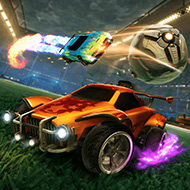
Rocket League looks like soccer with cars bolted on for novelty, but it plays like an aerial puzzle wearing a sports game’s rules as a disguise. The ball barely touches the ground in high-level matches, and most of what separates a beginner from a Grand Champion has nothing to do with driving and everything to do with reading boost, rotation, and airtime.
| Genre | Vehicular soccer |
| Match length | Five minutes, plus overtime if tied |
| Core resource | Boost, capped at 100 per car |
| Extra modes | Rumble, Hoops, Dropshot, Snow Day |
Rocket League Looks Like Soccer With Cars but Plays Like an Aerial Puzzle
Ground play dominates a first-time player’s instincts, but that instinct stops scaling almost immediately once boost management and aerial control enter the picture. The ball spends a huge share of high-level matches in the air, and a car that can’t challenge it there is functionally a spectator during the moments that decide most goals.
Boost Management Decides More Matches Than Shooting Accuracy
Boost caps at 100 and drains fast under sustained use, turning every pad on the field into a resource decision, not just a pickup. Big pads refill boost fully; small pads top off a partial tank. Players who chase every big pad greedily often arrive late to challenges a boost-efficient teammate would have already won.
Kickoffs: The Five Seconds Rocket League Players Argue About Most
The opening kickoff gets disproportionate attention in ranked discussion, and for good reason — a fast, clean kickoff that beats an opponent to first touch sets the tone for the possession battle that follows. Fumbling a kickoff against a faster opponent routinely hands away an early, avoidable goal.
Aerial Hits, Flip Resets, and the Skill Ceiling Nobody Reaches Fast
- Basic aerial hits require judging boost timing and car angle simultaneously, which takes most players real hours to feel natural.
- Flip resets — landing a wheel-touch on the ball mid-air to refresh a flip — sit near the top of the mechanical skill ceiling and separate freestylers from everyone else.
- Ceiling shots demand precise wall-to-air transitions that punish even small timing errors with a wasted possession.
Octane, Dominus, and Why Hitbox Shape Actually Matters
Every car in Rocket League shares identical stats underneath its body, but hitbox shape genuinely changes how a car interacts with the ball. The Octane’s balanced hitbox makes it the most common competitive pick, while a Dominus’s flatter profile changes dribbling and low-touch precision enough that switching between them retrains muscle memory.
Rotation: The Unwritten Rule That Separates Ranks
Rotation — cycling between offense, defense, and boost collection in a predictable pattern with teammates — is rarely taught directly, yet it’s the clearest divider between lower and higher ranks. Two players ball-chasing the same play at once is one of the most common, avoidable ways a team gives up an open net.
Rumble, Hoops, Dropshot, and Snow Day Change the Core Rules
Rumble adds temporary power-ups that override standard physics briefly. Hoops swaps the goal for a basketball-style net, changing shot angles entirely. Dropshot removes the ball’s bounce off a breakable floor, rewarding a different kind of aerial control. Snow Day replaces the ball with a puck that skates rather than bounces, flattening the game’s usual aerial emphasis into something closer to hockey.
Reading a Demo as a Tactical Tool, Not Just Aggression
Demolishing an opponent’s car does more than remove them from a play for a few seconds — it can flip momentum on a defensive stand or clear a lane for a teammate’s shot. Treating demos purely as aggression misses how deliberately timed ones function as a genuine defensive tool in higher-level play.
Does car choice actually affect gameplay, or is it cosmetic?
Hitbox shape is a real gameplay factor — cars like Octane, Dominus, and Breakout each interact with the ball differently despite sharing identical underlying stats.
Why do high-rank matches look so different from casual ones?
Boost efficiency, aerial control, and disciplined rotation compound heavily at higher ranks, turning matches into a much faster, more airborne game than casual ground-based play.
What’s the fastest way to improve past a rotation-heavy plateau?
Deliberately practicing boost-efficient rotation patterns in Freeplay, rather than only grinding mechanical shots, tends to raise rank faster once basic ball control is solid.
Rocket League keeps its ceiling absurdly high because every mechanical skill — a clean kickoff, a flip reset, disciplined rotation — stacks on top of the others, and the gap between a player who can hit the ball and one who can consistently win the boost battle around it never really closes.