




















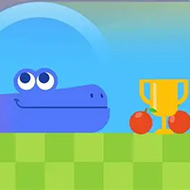
Google Snake at Browser




Google Snake On Browser looks like it should be effortless — eat the apple, grow longer, don’t hit yourself — until your snake stretches across half the board and every turn suddenly has to account for a tail that’s twice as long as it was thirty seconds ago.
Growth Is the Real Difficulty Curve in Google Snake On Browser
Unlike most action games, Google Snake On Browser doesn’t ramp difficulty through faster enemies or tighter timers — the challenge comes entirely from your own success. Every apple eaten adds length, which shrinks your available maneuvering space on a fixed-size board. Early in the game, turning sharply costs nothing; once the snake reaches real length, the same sharp turn can trap you against your own tail.
The board edges function as a hard wall in most versions, which means players have to plan routes that avoid both self-collision and edge collision at the same time. Circling the outer edge is a common beginner habit, but it stops working once the tail grows long enough to block the loop you were relying on.
What Beginners Get Wrong in Google Snake On Browser
The most common mistake is chasing every apple on screen without thinking about the route back. A new player will grab an apple in a tight corner without considering that the resulting extra length just closed off their exit path. Slower, more deliberate players who plan two or three moves ahead consistently outlast players who react apple to apple.
Speedrunners treat Google Snake On Browser differently than casual players do, optimizing for the shortest safe path between apples rather than just survival. That community has its own vocabulary around “wall-hugging” and “tail-baiting,” terms that describe deliberate positioning tricks rather than accidents, and watching a high-level run makes clear how much route planning separates a long survival session from a short one. Competitive players and casual players are drawn to the same simple board for very different reasons — one group treats it as a relaxed pastime, the other as a precision routing puzzle.
- Does the snake move faster as it grows in Google Snake On Browser? The base speed generally stays constant while the snake grows, so the difficulty comes from reduced maneuvering room rather than a faster game clock, though some game modes do add speed as an extra challenge layer.
- What’s the safest early strategy for staying alive longer? Sticking to open areas of the board and avoiding tight loops until the snake is short keeps escape routes available, since a short snake can recover from a bad turn far more easily than a long one.
Google Snake On Browser proves that a familiar concept doesn’t need new mechanics to stay challenging — the snake’s own growth is the entire difficulty system, and every apple you eat quietly makes your next ten seconds harder than your last. That simple trade-off is exactly why the format has stuck around as long as it has.