














Grand Theft Auto



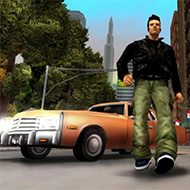
In Grand Theft Auto you start as a nobody criminal taking jobs from gangsters who barely know your name, and the camera keeps you zoomed out and top-down the entire time — a choice that turns every getaway into a puzzle of reading traffic patterns rather than reacting to what’s directly in front of your car.
| Genre | Top-down action, crime |
| Cities | Liberty City, San Andreas, Vice City |
| Structure | Six levels across three cities |
Why Grand Theft Auto’s Top-Down View Still Holds Up
The camera zooms out further the faster you drive, which sounds like a small detail but ends up shaping the entire pace of a level. High-speed chases become readable because you can see several blocks ahead, but that same zoomed-out view makes close-quarters moments — ducking into an alley, weaving through a tight intersection — feel riskier, since small obstacles are harder to judge precisely from that distance.
New players used to closer, character-focused cameras from later entries in the series tend to misjudge turns constantly in the earlier levels, because the top-down perspective rewards planning a route in advance rather than reacting to what’s immediately ahead of the car.
Liberty City, San Andreas, and Vice City as Distinct Playgrounds
Each of the three cities carries its own texture even within the same top-down structure. Liberty City’s early levels lean into dense, grid-like streets that punish careless driving, while San Andreas opens up with more sprawling routes that reward players willing to scout a longer path instead of forcing a direct line. Vice City’s levels close out the game with the sharpest difficulty spike, layering more aggressive police and rival attention onto missions that already demand precise driving.
Working for the Mob Without a Face
Missions are handed down anonymously, job to job, and success is measured almost entirely by completion rather than by any dialogue-driven relationship with the people assigning them. That facelessness is a deliberate part of the tone — you’re disposable muscle climbing a ladder that doesn’t care who’s on which rung, and the six levels across the three cities escalate the stakes without ever softening that framing.
- Use the zoomed-out view to plan routes before a chase starts, not mid-chase
- Treat San Andreas’s open layouts as an opportunity to lose pursuers with distance rather than tight turns
- Expect Vice City’s later levels to punish the same driving habits that worked fine back in Liberty City
What Players Still Debate About the Original
Longtime fans of the series argue constantly about whether the top-down format holds up next to the open-world entries that followed it, and Grand Theft Auto usually comes out of that debate better than expected — the anti-social freedom the game leans into, doing jobs for whichever gang pays best, reads as more mechanically honest about the character’s amorality than some of the more narrative-heavy sequels.
- Does the difficulty scale evenly across the three cities? No — Vice City’s levels are noticeably harder than Liberty City’s opening levels, with San Andreas sitting in between as the transition point where the game starts expecting more precise driving.
- Why does the top-down camera zoom out at high speed? It’s there to keep fast driving readable, giving players enough advance sightline to react to obstacles and police at speeds that would otherwise outrun a closer camera.
By the time the credits roll on the sixth level, Grand Theft Auto has made its point without ever naming a single boss you actually trust — Liberty City, San Andreas, and Vice City all use you the same way, and the game never pretends otherwise.