








PJSK Online




Why would a rhythm game bother building five separate friend groups with their own colors, symbols, and emotional themes when the actual gameplay is just tapping notes in time? PJSK Online answers that by making the Sekai worlds themselves the reward — the rhythm charts are the door, and the characters are why you keep opening it.
Tap, Hold, Flick, Slide: The Note Language of PJSK Online
The note types sound simple in isolation, but combined into full charts on higher difficulties, they demand a kind of pattern-reading that individual note practice doesn’t fully prepare you for. Flick notes especially trip up players coming from simpler rhythm formats, since they require a directional read in addition to timing, and charts stack flicks against holds in ways that punish players who’ve only drilled taps.
Difficulty scaling in PJSK Online isn’t just about note density either — higher difficulties introduce more overlapping note types in the same short window, which is why a player comfortable on mid-tier charts can still get overwhelmed the moment a song’s master-level chart starts layering flicks under a sustained hold.
Six Virtual Singers Behind Every PJSK Online Unit
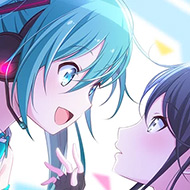
Hatsune Miku, Megurine Luka, Kagamine Rin and Len, Meiko, and Kaito form the connective tissue running underneath all five human units, since the songs themselves originate from this Virtual Singer catalog before being reinterpreted by the units. Understanding that layered relationship changes how the game reads — the human characters aren’t performing generic pop songs, they’re each interpreting the same shared musical world differently.
Leo/need and the Weight of Memory
Ichika Hoshino, Saki Tenma, Honami Mochizuki, and Shiho Hinomori make up Leo/need, tied to the School Sekai and represented by a shooting star under a blue color scheme built around memories. Their songs and story beats lean into childhood-friend dynamics, and the shooting star motif recurs specifically around moments where the group has to decide whether to hold onto the past or move past it.
MORE MORE JUMP!’s Optimism Problem
Minori Hanasato, Haruka Kiritani, Airi Momoi, and Shizuku Hinomori represent hope through a green color scheme and a three-leaf clover symbol, performing in the Stage Sekai as idol singers. Their material leans brighter than most of the other units, which some players find refreshing against heavier storylines elsewhere and others find thin compared to the emotional weight carried by units like Nightcord at 25:00.
Vivid BAD SQUAD’s Chip on Its Shoulder
Formed specifically to surpass a legend, Vivid BAD SQUAD carries a competitive edge that shows up in both their Street Sekai setting and their material, which leans harder into confrontation and drive than the more introspective units around them.
Wonderlands x Showtime’s Performance-First Identity
Tsukasa Tenma, Emu Ootori, Nene Kusanagi, and Rui Kamishiro make up Wonderlands x Showtime, tied to the Wonderland Sekai and represented by a crown under an orange color scheme centered on happiness. Their whole identity revolves around putting on a good show rather than processing personal conflict, which makes them the unit most players point to when discussing PJSK Online’s lighter tonal range.
Nightcord at 25:00 and the Cost of Staying Up Too Late
Kanade Yoisaki, Mafuyu Asahina, Ena Shinonome, and Mizuki Akiyama make up Nightcord at 25:00, gathering in the Empty Sekai under a muted purple color scheme built around a broken heart symbol representing trauma and healing. Their material is consistently the heaviest of the five units, and it’s frequently cited as the entry point that pulls in players who came for the rhythm gameplay and stayed for the writing.
- Practice flick-heavy charts in isolation before attempting master-level songs that stack them under holds
- Learn one unit’s Sekai and color identity fully before splitting attention across all five — the emotional throughlines land harder that way
- Treat the Virtual Singer originals as the foundation the human units are reinterpreting, not a separate, unrelated catalog
Which unit is considered the hardest to get into emotionally?
Nightcord at 25:00 tends to divide new players the most — the trauma-and-healing themes tied to Kanade Yoisaki, Mafuyu Asahina, Ena Shinonome, and Mizuki Akiyama land harder for some than the brighter material from units like MORE MORE JUMP!.
Do the five units share songs with each other?
They share the underlying Virtual Singer catalog as source material, with each unit’s own interpretation shaping how a given song actually plays out in their specific Sekai.
Whether you came to PJSK Online for the flick-heavy charts or ended up staying for Nightcord at 25:00’s heavier material, the game’s real trick is making the rhythm skill and the character investment impossible to fully separate.