

















Explosive Chasers







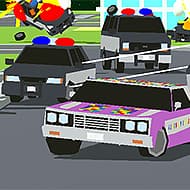
You hold W, snap the wheel left with A, and the police vehicle blocking your lane erupts into a fireball that leaves a stack of coins on the asphalt. That single second of cause and effect is the entire pitch of Explosive Chasers, a driving and destruction run where every wrecked car pays you for the mess. The goal is easy to say and harder to pull off: stay alive as long as you can while the chase gets heavier around you.
| Genre | Arcade racing with vehicle combat |
| Platforms | Windows and Android |
| Session length | A few minutes per run |
| Controls | Keyboard or touchscreen |
| Goal | Survive the police chase and earn coins |
How Explosive Chasers Turns Every Chase into a Coin Run
A run starts with you behind the wheel and police vehicles closing in from several directions. Your job is to blow up whatever gets in your way with an arsenal of weapons, and every destroyed vehicle drops coins. The longer you survive and the higher your level climbs, the bigger those payouts become. Those coins are what you spend on new cars and new arenas between runs, and since sessions last only a few minutes, the game rewards quick restarts far more than long planning.
Beginners usually treat the chase like a pure driving test and try to dodge everything. That works for a short stretch, but it leaves money on the table, because your weapons are what feed the whole economy. Early in the game, a clean escape pays noticeably less than a messy one full of wrecks.
Think of it as a demolition derby where you are the target and the wrecking crew at once. Arcade players who love chasing a higher coin total will feel the loop immediately: run, destroy, spend, repeat. Nothing slows that cycle down, which is why one more try tends to turn into ten.
Gas, Handbrake, and the Special Power on S
The keyboard layout is compact, with five keys covering the whole run:
- W for gas
- S for brake and Special Power
- A for steering left
- D for steering right
- Space for the handbrake
Because S works as both brake and Special Power, it is worth treating as a deliberate button rather than a reflex tap. Slamming it to slow down in a tight spot is one thing, but pressing it at the wrong moment is the easiest way to burn your best tool just as a wall of police vehicles closes in.
Space is the handbrake, and it separates a smooth run from a stiff one. Tapping it into a turn swings the rear end around so you can line up a target or slip out of a pinch between two police vehicles. The handling leans arcade rather than simulation, so slides are forgiving once you find the rhythm. Players on Android use touch input instead of keys, and a precise handbrake slide feels very different when it lives on a screen rather than under your thumb.
Police Vehicles, Damage, and the Revive System
Police vehicles are what you are really running from, and colliding with them is the mistake to avoid while you wreck everything else. The damage and revive system means a bad hit does not always end the run on the spot, which gives newcomers room to learn. Once you understand that safety net, you can take slightly riskier lines toward the vehicles you want to blow up.
Random weather now rolls into the arenas, so the same arena rarely looks identical twice. Some weapons also trigger a destruction flash effect at random, which sells the biggest wrecks and makes a good chain of explosions feel earned. Difficulty is progressive, so by the time your level climbs higher, the chase simply asks more of your steering and your timing.
There is an honest criticism worth knowing about. Some players point out that running away and following the coins can be easier than fighting, and they suggest faster police vehicles to force more crashes. Others would like upgrades that feel less like pressing a plus button. That is fair feedback for a game still in pre-alpha, and it explains why the loop sometimes feels more relaxed than the chaos suggests.
Unlocking Cars and Arenas in Explosive Chasers
Coins are the single currency that matters, and they unlock both new cars and new arenas. Causing greater chaos is how you get there, so the unlock path is tied directly to how aggressively you play rather than how carefully you drive. Completionists who want every vehicle and arena will find the grind steady rather than punishing.
The advanced habit most players miss is balancing risk against payout. A longer run raises your level, and a higher level raises every coin drop, so surviving past the point where it feels comfortable is usually worth more than one extra wreck. Pick fights you can finish and use the handbrake to reset your angle before the next police vehicle arrives.
Each new arena changes how much room you have to maneuver, which is why a car that felt perfect in one place can feel clumsy in another. Treat every unlock as an experiment rather than a pure upgrade. Match the car and the arena to the style you actually play.
Common Questions About Explosive Chasers
How do you earn coins faster?
Destroy as many vehicles as you can with your weapons, because each wreck drops coins. Stay alive long enough for your level to rise, since higher levels raise the payout. Avoiding collisions with police vehicles keeps the damage and revive system from becoming your only safety net.
What does S do besides braking?
S doubles as the Special Power, so it works as both brake and special move. W stays on gas, A and D steer, and Space is the handbrake. Learn to use S on purpose in crowded moments rather than tapping it out of habit.
Can you play on Android or in a browser?
There are releases for Windows and for Android, and the Android one uses touch controls for the same chase, coins, and police vehicles. A browser release has not been possible so far because of engine limits. If you want to try it, plan on a download.
Explosive Chasers works because every crash feeds the next upgrade: a well-timed Special Power, a handbrake slide into a police vehicle, and a fistful of coins that bring the next car one run closer. The pre-alpha rough edges are real, but the loop already hooks you in minutes and refuses to let go.