


















Mini Motorways






In Mini Motorways every run starts almost empty: one destination, a few houses of the matching color and a short supply of road tiles. That calm lasts only a few minutes, and the choices you make while the map is quiet decide how badly it jams later.
| Genre | Minimalist traffic puzzle |
| Goal | Keep every pin from overflowing as the city grows |
| Maps | Simplified real cities such as London, Paris, Dubai and Wellington |
| Tools | Road tiles, bridges, tunnels, roundabouts, traffic lights, motorways |
| Platforms | PC, Mac, iOS, Nintendo Switch |
Houses, Destinations and Pins: Reading the Board in Mini Motorways
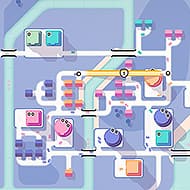
Each house sends cars to a destination of the same color, so red cars need red buildings and blue cars need blue ones. New houses and destinations appear at random, sometimes with the matching color on the far side of a river. Pins gather above a destination when cars are waiting, and a pin timer that fills up ends the run. One detail helps more than most: houses never appear on top of an existing road.
Beginners tend to give every house its own straight road to its destination. That burns through tiles faster than anything else and leaves nothing for the busy weeks ahead.
Check the pins and timers on every destination at the start of each week. The quiet destination at the edge of the map is usually the one that fails you, because nothing about it looks urgent until its timer is almost full.
Road Tiles and the 40 Percent Diagonal Trap
Roads are the basic currency of Mini Motorways, and you always receive more tiles for the coming week. A diagonal road uses the same number of tiles as a straight one but is about 40% longer, which means cars spend more time on it. That matters most when you draw a road from a remote house to a destination across the map, because the shortest line on paper is not always the fastest for traffic. A compact network keeps the numbers working in your favor.
Short roads and small clusters beat long single lines. Link two or three houses into one alley, then feed several alleys into a main artery.
There is no penalty for moving roads, so tearing a section down and redrawing it is part of normal play. Spare tiles can also be placed on empty ground to stop houses from appearing in a spot you want to keep clear. Perfectionists who chase high scores treat the map like clay, reshaping it every week.
Weekly Upgrades: Bridges, Tunnels, Roundabouts, Traffic Lights and Motorways
At the end of each week you pick an infrastructure piece to go with your new road tiles. Bridges cross water, tunnels cut through mountains, roundabouts keep junctions moving and traffic lights manage crossing flows. Motorways run over buildings and other roads, let cars travel faster and connect two points at almost any distance, which is why they are the pick veterans fight over.
Opinions differ on traffic lights. Some players call them useful, while others say they slow everyone down and make a jam worse.
By the middle of a long run, houses often pop up on the opposite side of the city from their destinations, and a motorway across the middle becomes the only real fix. Players who started with Mini Metro will recognize the upgrade choice immediately, though here a wrong pick shows up as cars crawling rather than trains waiting.
When Colors Collide: Untangling a Jam in Mini Motorways
Mid-run is where the board turns dangerous. Destinations upgrade their capacity, but each upgrade seems to double the number of houses linked to it, so a calm network suddenly carries twice the cars. Red routes cross blue ones, green and purple roads spaghetti around both, and a single bottleneck can freeze several colors at once.
Separating roads by color is the standard cure. If a color cannot be rerouted, some players cut it off from the shared road and give it a private path.
Emergency rerouting is the skill that saves runs, since a flashing destination about to end your game can often be reached by dragging one road across a bridge or onto a motorway. Relaxed players who treat the game as a calm commute will still find themselves leaning forward at that moment.
Daily Challenges and Why Each City Feels Different
The cities are simplified versions of real places such as London, Paris, Dubai and Wellington, drawn without roads so you supply the network. Rivers and coastlines become the obstacles that decide where bridges and tunnels matter. That is why a layout that works in one city fails in the next, and why the same upgrade pick can be perfect on one map and wasted on another.
Daily and weekly challenges take the standard maps and add modifiers. Bridges might cost double the road tiles, or you might start with maxed-out motorways.
Honest criticism usually lands on content. Reviewers note that there are fewer maps than in Mini Metro, and players who tear through the cities quickly may feel the supply running thin. The challenges and the chase for higher scores are what keep most runs going after that.
Questions Players Ask About Mini Motorways
- How do you stop traffic jams in Mini Motorways? Keep roads short, group houses into small alleys and feed them into a main artery instead of drawing a separate line for each house. When a jam still forms, redraw the problem section, since moving roads carries no penalty.
- Are motorways worth using in Mini Motorways? Yes, especially in the middle and late stages when houses appear far from their destinations. A motorway runs over buildings and other roads, so one well-placed piece can clear several crossing routes at once.
- Is Mini Motorways relaxing or stressful? Both, depending on the stage of the run. The opening minutes feel gentle, but once pins pile up and timers start filling, it turns tense in a way that keeps players coming back.
Mini Motorways is at its best when a pin timer is nearly full and one road dragged across a bridge or onto a motorway brings the whole board back from the brink. That mix of calm layout and sudden panic, whether in London or Dubai, is why one more run is so hard to resist.