








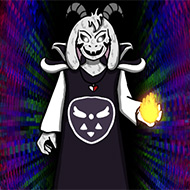
Asriel Fight Simulator

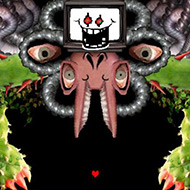




You dash the SOUL into the corner of the Bullet Board as the first stars ignite overhead, and for a moment the screen is white light and falling debris. That instinctive dodge, made before you’ve read the pattern, is the whole pitch of Asriel Fight Simulator: one boss, one arena, a heart-shaped SOUL that either learns to move or gets erased.
Stepping Into Asriel Fight Simulator’s Bullet Board
The core mechanic: you steer the SOUL, a small red heart, inside a bounded box while Asriel Dreemurr fills the space with projectiles. There’s no menu beyond the opening text; once the fight starts, survival is pure movement, and HP is the only score.
The first two minutes set expectations fast. Asriel Dreemurr speaks briefly, the board’s edges snap into view, and the opening attack lands before you’ve finished reading. Newcomers usually lose HP right here, expecting a gentler ramp-up.
Unlike a normal Undertale encounter, MERCY is unavailable. ACT and Spare are stripped to nothing, leaving movement as the only real tool, which signals an endurance test rather than a narrative beat.
How Asriel Dreemurr’s Phases Escalate
Asriel Dreemurr cycles through eight named attacks, several returning later in upgraded forms. Bullet-hell veterans recognize the design instantly: each attack telegraphs itself, then punishes you for misreading it.
- Star Blazing, later replaced by the faster Galacta Blazing
- Shocker Breaker, escalating into Shocker Breaker II’s sweep
- Chaos Buster, whose telegraph becomes the random Chaos Blaster
- Chaos Saber, a five-swipe blade pattern with residual sparks
- Hyper Goner and Angel of Death, the late-phase pieces
Once Asriel shifts to his next phase, a survived attack often returns faster or stripped of its readable cue. Base attacks are learnable; upgrades just demand faster reflexes.
One detail you only notice from actually playing: Hyper Goner fills the board edge to edge before a vortex opens, pulling the SOUL in as diamond hazards drift in. Standing still here is itself a losing choice.
Common Early Mistakes With the SOUL
New players hover near the board’s center out of habit, exactly where Star Blazing’s rings do the most damage. During Chaos Buster’s telegraph, moving out of panic is another mistake, since that cue asks you to hold still. Undertale fans testing their reflexes here often assume prior game knowledge carries them through, and it rarely does.
Pattern Memorization and Safe Zones
Pattern memorization is the phrase this community uses constantly. Nearly every attack hides a safe zone, whether a gap in Chaos Saber’s swipe order or the strip along the board’s edge where Angel of Death’s comets arrive last.
- Watch an attack’s first cycle just to see its shape
- Identify which cue means “move” and which means “hold still”
- Commit to a fixed safe zone instead of reacting bullet by bullet
- Adjust once the upgrade changes the timing
Not everything here feels fair. Chaos Blaster dropping its telegraph to fire at random is genuinely divisive, punishing the same memorization skill the fight otherwise rewards. Some call it the signature test; others call it a cheap break from the design.
What Asriel Fight Simulator Leaves Out of the Full Story
This is a simulator in the strictest sense: it isolates one boss encounter and strips away everything around it. No exploration, no relationship-building, no save file riding on the outcome, just the fight, looped as many times as it takes.
That isolation cuts both ways. It’s easier since failure costs nothing beyond a quick restart, with none of the dread of risking a full playthrough, but harder because the pacing between attacks is gone, leaving the fight feeling more relentless.
Bullet-hell veterans with no Undertale background treat it as pure execution, and the game holds up fine there. The fast respawn loop keeps every attempt short enough that trying again feels effortless.
Common Questions About Asriel Fight Simulator
- Is there a mercy option? No. MERCY stays unavailable, mirroring the source fight, so ACT and Spare give way to movement-only survival against Asriel Dreemurr.
- How many attacks does Asriel Dreemurr use? Eight named attacks, including Star Blazing, Shocker Breaker, Chaos Buster, Chaos Saber, Hyper Goner, and Angel of Death, several with upgraded variants.
- Is this harder than the full boss fight? It depends: losing costs nothing since no save file is at stake, but with narrative pauses removed, the SOUL faces the patterns back to back with far less breathing room.
Strip away the dialogue and the wider story, and what’s left is exactly what Asriel Fight Simulator promises. A small heart, a hostile arena, and Asriel Dreemurr testing whether you’ve learned his patterns or just memorized his name.