












TOEM 2



The camera in TOEM 2 does not just record the world, it opens paths, solves puzzles and uncovers secrets. That single idea is the engine of this sequel, a black-and-white photo adventure set a few years after the original story, where a newly awakened passion for photographing mysterious events called TOEMs sends you back out into the world.
How the First-Person Camera Works in TOEM 2
Most of the game plays from a top-down, 2.5D-style perspective, but the moment you raise the camera it switches to first person and lets you compose the shot yourself. That switch is the best moment-to-moment detail in the whole adventure: the world goes from a map you navigate to a frame you judge. You stop asking where to walk next and start asking what is worth capturing.
Snapping the right subject solves puzzles, uncovers secrets and documents your discoveries. Early in the game that mostly means noticing what looks out of place, a character who needs something, a detail that does not quite fit, or a corner of the scene that seems to be asking for attention. The camera rewards patience far more than reflexes, which suits the relaxed tone.
Looking carefully is the real skill.
Players who love photography as a hobby will feel at home, because framing, subject and timing all matter. Players who just want a clear objective get one too, since the game treats the camera as the way you answer almost every question it asks. Either way, the first-person view makes each photo feel like a small decision rather than a button press.
Camera Attachments and Puzzle Logic
Your camera has been upgraded for the sequel, and the headline change is attachments. They let you use photography in less obvious ways to overcome problems specific to each region, which means a puzzle can ask for a tool as well as a good angle. It is a smart extension of the core idea, because the camera stays your only real instrument while its uses keep widening.
Once a new attachment arrives, the way you read a scene changes. A ledge that looked decorative may become a route, and an obstacle that blocked you earlier may suddenly have an answer. By the time you reach a later region, you are less likely to ask what the puzzle wants and more likely to ask which tool the region is hinting at.
Puzzle fans should expect a gentle difficulty curve rather than brain-melting riddles. The game is designed around curiosity, so a stuck player is usually one good look away from the solution. That makes the attachments feel like a reward for exploring instead of a gate that holds you back.
Run, Jump and Climb: The Shift From 2D to 3D in TOEM 2
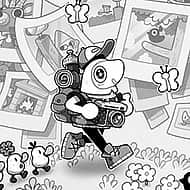
The first TOEM was a 2D adventure. The sequel moves to 3D environments while keeping the monochrome look and the sprite-style characters, and it adds a snappier movement system. You play a more confident adventurer who runs, jumps and climbs, which means vertical routes, hidden paths and scenic viewpoints are now part of the map.
The new verticality rewards curiosity more than skill. Climbing to a viewpoint is a way to spot a small detail you would miss at ground level, and the world is built to reward wandering wherever your camera leads you. Returning fans will notice how different the sequel feels once the world is no longer locked to a flat plane.
The jump to 3D also changes how you look for secrets. A route that seemed closed from the front may open from behind, and a hill that looked like scenery may be the way up to a hidden spot. Explorers who like to circle every landmark will find the new perspective very generous.
Black-and-White Art, Music and Cozy Pacing
The art style deserves a note. Without color to guide you, light, shape and contrast carry the visual cues, which makes the world readable in a different way. Some players may miss the signals color would normally give, but that limitation is part of the identity, and it is why the move to 3D still feels like the same series.
Music and pacing matter just as much. The game encourages you to take in the scenery, listen to the music and smell the flowers, and it backs that up with no time limits or tricky requirements for full completion. You are never racing a clock, so you can stop at a viewpoint and take as many photos as you like.
That slow rhythm is the whole point. It turns a stroll through a region into a small ritual of looking, climbing and photographing, and it makes the game a good fit for short evening sessions. Players who want constant action should adjust their expectations, because the calm is deliberate.
Journal Stamps, the Critter Compendium and the Cast of TOEM 2
Photography is paired with a gentle quest structure. You meet a cast of new quirky characters and adorable critters, lend a hand to new faces and form lasting friendships. As quests and discoveries pile up, you fill your journal with stamps and expand your critter compendium, which gives the world a satisfying collection loop.
Helping is the point. Rather than clearing tasks to unlock the next gate, you are asked to notice what people need and what the world is hiding, and the camera is how you answer. Once you have a few stamps, the journal becomes a record of where you have been and who you have helped, a kind of photo album with receipts.
Completionists can chase the compendium and stamps, while players who prefer to wander can ignore them. Because the game states that full completion has no hard requirements, the collecting never turns into a checklist chore. You can catalogue your memories at your own speed and still feel like you are making progress.
Who Should Start With TOEM 2 and What May Not Land
You do not need to have played the first TOEM. The sequel was crafted to welcome both returning fans and newcomers, and because the story is set a few years after the original, the mystery of TOEMs is explained along the way. Players who loved the BAFTA-winning original will find the same warmth, with more room to move.
The honest caveat is pace. A game with no time limits and no hard requirements for completion is gentle on purpose, and players who want demanding puzzles or tight challenges may find it too relaxed. It is a cozy adventure first, and it asks you to meet it on those terms.
Players who enjoy photography will get the most from the framing, and anyone who likes cozy collection games will feel at home with stamps and critters. If you want speed, look elsewhere; if you want curiosity rewarded, this game fits. It is also a single-player adventure, so there is no pressure from anyone but yourself.
Questions Players Ask About TOEM 2
Do you need to play the first TOEM before starting TOEM 2?
No. The sequel was made to welcome newcomers as well as returning fans, and it is set a few years after the original story. The TOEMs, the events you photograph, are introduced as you go, so you can start with the camera and learn from there.
Is TOEM 2 in 3D?
Yes, the environments are 3D, though the look stays black and white with sprite-style characters. Most of the time you see the world from a top-down, 2.5D-style view, and the game switches to first person whenever you lift the camera to compose a photo.
How does the camera solve puzzles in TOEM 2?
You snap pictures of the right subjects to solve puzzles, uncover secrets and document discoveries. New camera attachments extend this, letting you tackle region-specific problems in less obvious ways than a plain photo, which is why exploring each area carefully pays off.
TOEM 2 turns a camera, a journal and a world of small mysteries into a gentle photo adventure. Whether you are chasing a TOEM, filling the critter compendium or just climbing a hill to take one more picture, this game is built around noticing things.