
























Beltmatic













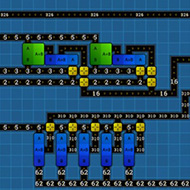
A single generator producing the number one does not look like much, but Beltmatic turns that one plain digit into an entire logistics problem the moment you start routing it toward a target value. Every solution in this game is built from three simple pieces — generators, operator buildings, and collectors — and the entire challenge is deciding how belts connect them without creating a jam.
| Genre | Factory automation puzzle |
| Core mechanic | Routing numbers through math operator buildings |
| Building blocks | Generators, operators, collectors, belts |
| Goal | Reach target numbers through efficient layouts |
Beltmatic Turns Arithmetic Into a Factory Layout Problem
Numbers behave like physical goods here. A generator produces a base value, that value travels along a belt, and passing it through an operator building changes it according to a fixed rule — addition or multiplication, depending on the building. The math itself is simple; the challenge is entirely spatial, since belts, operators, and collectors all compete for the same limited grid space.
Generators, Operators, and Collectors: The Three Building Blocks
Generators are where every number in Beltmatic originates, and they never stop producing once placed. Operator buildings are the only thing capable of changing a number in transit, applying their fixed rule to whatever passes through. Collectors sit at the end of the chain, accepting a finished number as a completed goal. Nothing else in the game changes a number’s value — everything else is just plumbing.
Why Belt Routing Matters More Than Building Placement in Beltmatic
- Two identical sets of generators and operators can produce wildly different output speeds depending purely on how belts are routed between them.
- Crossing belt paths unnecessarily creates congestion points that slow the whole system down, even when no single segment is technically overloaded.
- Short, direct paths between operators consistently outperform layouts that loop numbers around for aesthetic reasons.
Addition, Multiplication, and Chaining Operators Efficiently
Reaching a specific target value almost always means chaining multiple operators in sequence rather than relying on a single building to do all the work. Multiplication operators scale a value fast but can overshoot a target if placed carelessly, while addition operators offer finer control for closing the last gap between a chained result and the number a collector actually needs.
Bottlenecks: The Mistake Every New Beltmatic Player Makes
The most common early mistake is treating belt capacity as unlimited. It isn’t — a single belt segment can only carry so much throughput, and feeding two generators into one belt without planning for that limit is the single fastest way to watch an otherwise correct layout grind to a crawl.
Community discussion around Beltmatic often centers on this exact issue, with experienced players trading layout screenshots the way other puzzle communities trade solved boards.
Reading Throughput Instead of Just Watching Numbers Move
Numbers moving across the screen look satisfying, but they don’t tell you whether a layout is actually efficient. Players who improve fastest learn to judge throughput — how much output a collector receives per unit of time — rather than just confirming that a target number eventually arrives.
Beltmatic’s Late-Game Layouts Get Genuinely Complicated
Early targets can be solved with a handful of generators and one or two operators. Later targets routinely require dozens of components arranged across a much wider grid, and untangling a layout that technically works but wastes space becomes its own separate puzzle on top of the math.
Why Some Players Find Beltmatic’s Math Focus Divisive
Not everyone enjoys a puzzle game built this explicitly around arithmetic. Some players find the pure math framing more engaging than typical factory games because there’s no ambiguity about whether a layout works. Others find the lack of any narrative or visual variety wears thin over longer sessions, and that split shows up consistently in community discussion.
Beltmatic rewards the same instinct good factory games always have, just stripped down to numbers and belts — a collector finally accepting a stubborn target value after three redesigned operator chains feels earned in a way that has nothing to do with decoration and everything to do with getting the throughput right.