
























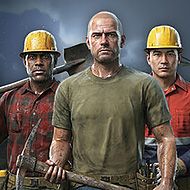
Ore Factory Squad














Ore Factory Squad looks like a cozy digging sandbox from the thumbnail, but it plays like a logistics job you can’t clock out of. You start with a small warehouse and a shovel, and within a few in-game days you’re managing conveyor routes, machine upgrades, and delivery contracts across multiple properties — solo or with up to four players in the same operation.
| Genre | Co-op mining and factory-building game |
| Player count | Solo or up to four players |
| Core loop | Mine, process, automate, deliver |
| Starting point | A small warehouse property |
Digging Without Fixed Paths
Every property in Ore Factory Squad is procedurally generated underground, and the terrain is fully diggable — there’s no set tunnel layout waiting for you, which means the shape of your mine is entirely a product of where you decide to dig. That freedom is appealing early on, but it also means beginners often carve chaotic, wandering tunnels that make later hauling routes a nightmare to manage.
Ore distribution is randomized per property, so a site that looks thin on the surface can hide a dense pocket a few layers down, and vice versa. Exploration-minded players tend to dig wide and shallow first just to map out what a new property is hiding before committing to a deep shaft.
Once you’ve cleared a property’s easy surface deposits, the game nudges you toward tougher ground where the next tool tier becomes necessary rather than optional.
From Shovel to Dynamite
Tool progression in the game is straightforward but meaningfully gated. You start with a basic shovel, move up to a pickaxe once you hit denser rock, unlock a jackhammer for speed once your factory is generating steady income, and eventually gain access to explosives that clear large sections instantly. Skipping straight to the more efficient tools isn’t possible — each one has to be earned through progression, so early digging is genuinely slower than what you’ll have access to later.
The deeper you go, the more valuable the ore tends to be, which turns every digging decision into a small risk calculation: keep excavating a known vein near the surface, or push down into unmapped ground where the payoff is higher but the ore mix is still unknown.
Turning Ore Into Contracts
Processing chains are where Ore Factory Squad shifts from a mining game into a factory sim proper — raw ore has to move through multiple machine stages before it becomes something you can actually sell, and each stage typically adds value if you route it correctly. Getting this right matters more than it first appears, because contracts pay based on finished goods, not raw material sitting in a pile.
Conveyor belts move ore between machines automatically once set up, and warehouse robots take over the manual stacking and hauling that becomes unmanageable once a factory scales past its first few machines. Skipping robots works fine on a small warehouse but stops scaling the moment higher-tier contracts start demanding steady output.
A mistake that shows up constantly in early playthroughs is laying sprawling conveyor networks before the machines powering them are even upgraded, which creates tangled routes players in the community call spaghetti — hard to trace, harder to fix once ore stops flowing through a dead branch.
Contracts, Cash, and Why Skipping Deliveries Backfires
Contracts are the game’s main income driver: complete one, get paid, reinvest into upgrades, unlock the next machine tier. It sounds simple, but a common beginner trap is skipping active contracts to keep mining “just a little more” ore first. That habit stalls cash flow fast, since the next tier of machines and tools is gated behind contract payouts rather than raw ore sitting unsold in storage.
Co-op players often split roles naturally — one person focused on digging and hauling, another managing the factory floor and contract queue — and that division tends to speed up early progression noticeably compared to one player trying to run both sides alone.
As properties expand across multiple surface pads, logistics stop being optional. Forklifts and trucks feel unnecessary on a single small warehouse, but the moment a factory spans more than one pad, moving goods manually between them eats enough time to blow through delivery windows on time-sensitive contracts.
What the Community Argues About
Not everything about Ore Factory Squad gets universal praise. Some players find the early game slow to open up, since your first warehouse limits both digging space and processing capacity until you can afford a second property. Others see that early constraint as intentional pacing that teaches the core loop before the game hands you enough scale to make mistakes expensive. Either way, it’s a point that comes up regularly in community discussion threads and reviews.
One moment new players consistently mention is the first time a jackhammer chews through a section of rock that would’ve taken a shovel several times as long — it’s a small mechanical shift, but it’s the clearest signal the game gives that your investment in tools is actually paying off.
Players managing licenses and machine unlocks also tend to debate priority order: some push toward processing upgrades first to maximize the value of ore they’re already pulling, while others prioritize digging tools to access deeper, richer ground sooner. Neither approach is wrong, but the choice noticeably changes how the first several hours feel.
Whether you’re tracing conveyor routes back to a jammed processor or watching a jackhammer finally replace the shovel you started with, Ore Factory Squad rewards the kind of player who enjoys untangling their own mess as much as building it. The warehouse you start in barely resembles the operation you’ll be running once dynamite and warehouse robots enter the picture.