






















60 Seconds









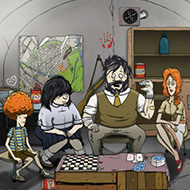
What happens when the sixty-second timer runs out and Ted still hasn’t grabbed Mary Jane from her bedroom? That dilemma sits at the center of 60 Seconds!, a dark-comedy survival game split into a frantic scramble through a suburban house and a longer fight to keep four people alive in a cramped fallout shelter. The opening minute decides almost everything that follows, and the shelter phase makes the player live with those choices for weeks of in-game time.
| Genre | Dark-comedy survival and resource management |
| Platform(s) | PC, consoles, mobile |
| Player Mode | Single player |
| Difficulty | Escalating, RNG-driven |
Why 60 Seconds! Starts With a Sprint Through the McDoodle House
Ted McDoodle wakes to air raid sirens with sixty literal seconds on the clock, and every object or family member he touches in that window is the only supply run he gets. The house layout stays fixed for a given attempt but is rarely memorized on a first try, so newcomers waste seconds orienting in the kitchen, bathroom, bedrooms, and garage. Dolores, Timmy, and Mary Jane are scattered through separate rooms, and reaching all three while grabbing Soup, Water, and a Rifle is close to impossible in one run.
Beginners almost always misjudge this phase, sprinting toward the closest door instead of looping through rooms that hold both people and supplies. It is common to finish with three family members and no Water, or a full pantry and only Ted locked inside. Both outcomes cripple the weeks ahead, since the shelter cannot generate people or supplies from nothing.
Players optimizing their scramble route settle on a fixed path that grabs Timmy first, since he starts nearest a doorway, before circling back for Dolores and Mary Jane. Route memorization is the only lever available before the blast.
The Items and Family Members Worth Grabbing First
Not every item pulls its weight once the shelter door shuts. The items that matter most include:
- Soup and Water, the only supplies that prevent starvation and dehydration
- The Rifle, used against raiders and indoor threats
- The Gas Mask, which protects whoever wears it on an expedition
- The Radio, which reports nearby supply caches and events
- The Boy Scout Handbook and playing cards, both of which hold off insanity
- The Map, MedKit, flashlight, and axe, which shape later expeditions
Family members are not interchangeable. Timmy scavenges fastest of the three, and losing any one early narrows the strategies left for the rest of the run.
Running the Shelter Once the Door Locks in 60 Seconds!
Once the blast passes, 60 Seconds! shifts into its second identity: a slow, grinding management game played out from four concrete walls. Each day the player decides how much Soup and Water to hand out, who stays inside, who gets sent out, and how to respond to whatever event knocks. Some events are yes-or-no prompts, others hand out or take away items outright, and a few reshape the rest of the run.
New players routinely burn through supplies giving everyone a full ration daily, not realizing that stretching rations across multiple people buys more total survival time. It usually takes losing someone to starvation before the lesson sinks in.
The radio doubles as what the community calls the map, marking nearby locations worth raiding for extra Soup, Water, or gear. Checking it daily costs nothing and often reveals a cache that turns a desperate week comfortable.
Rationing Soup and Water Without Starving Everyone
Ration math is the single most important skill the shelter phase teaches: a character survives roughly ten days without Soup and about five without Water, numbers that never move. Splitting a can of Soup or bottle of Water across two people, rather than feeding one person fully, often keeps both alive longer. By day 10 in the shelter, most families are already mixing full and half rations depending on who is sick or scavenging.
Sending Timmy, Mary Jane, or Dolores on an Expedition
Expeditions are where 60 Seconds! turns its resource shortage into an actual decision. Sending someone toward a location marked on the map might return canned goods, ammunition, or a rare item like a second Gas Mask, but it might just as easily return nothing, or return the family member injured, sick, or missing the item they brought. Difficulty settings raise the odds of bad outcomes, and a run feels punishing when several expeditions in a row fail.
Choosing who to send matters as much as where. Timmy’s speed makes him the safer default for short trips, while sending Dolores or Mary Jane out with the Gas Mask on cuts the chance they come back sick.
The dark comedy 60 Seconds! is known for shows up constantly here, from the family cheerfully weighing whether they might turn cannibalistic to survive, to sick characters leaking bright blue fluid from their noses as their eyes grow more bloodshot by the day. It is the kind of detail nobody describes accurately without watching it happen to their own Timmy.
What Sickness and Insanity Do to the McDoodles
Once Dolores falls ill, whether from an unprotected expedition, hunger, or a bad event, she will die or leave within roughly fifteen to twenty days unless treated with a MedKit or a lucky event. Insanity runs on a longer clock: a Deranged family member can last twenty to thirty-five days before running off, destroying an item partway through that countdown. Keeping the household sane leans on supplies that felt optional during the scramble, since cards, checkers, and the Boy Scout Handbook all chip away at stress.
How the Difficulty Curve Tightens After Day 10
Nothing about 60 Seconds! gets easier as a run goes; supplies only shrink, and the pool of healthy, sane family members shrinks with them. Early events are usually manageable, but once sickness, insanity, and injuries compound, a single bad expedition can tip a stable shelter into a death spiral within days.
It is worth being honest that a lot of this comes down to RNG rather than skill. Two players making identical decisions can end a run with wildly different outcomes, and that frustrates some players even as it keeps others replaying the run hoping for a better draw.
Advanced players optimize both ends of the game, memorizing a fast scramble path, then planning expeditions around whichever family member has the best odds for a given trip. Players who savor the dark humor let a run stretch past rational survival just to see which absurd event fires next.
The Vehicle, Agents, and Other Ways Out
60 Seconds! offers several distinct endings rather than one win state, most requiring specific conditions instead of simply outlasting the clock.
Scavenging every vehicle part, armor, a weapon mount, decoration, wheels, and fuel, lets the family drive away in the Vehicle ending. Following the radio toward a Military Takeover, or completing the right chain of events, can instead trigger the Agents ending, where a well-supplied shelter replaces the one Ted built.
Failure looks far less dramatic: family members die or wander off from starvation, sickness, or insanity until nobody is left, and the game simply ends without ceremony. That quiet failure is arguably more memorable than the good endings, since it is what most first attempts produce, and reaching a better one usually takes several runs.
Questions Players Ask About 60 Seconds!
- How long can family members survive without Soup or Water in 60 Seconds!? About five days without Water and ten without Soup, which is why rationing both across everyone tends to extend a run longest.
- What should Ted grab first during the opening scramble? Water, Soup, and at least one family member pay off more than grabbing everything near the door; the Rifle and Gas Mask are worth a detour, since both affect survival odds once expeditions begin.
- How do you get the Vehicle ending in 60 Seconds!? It requires scavenging every vehicle part, armor, a weapon mount, decoration, wheels, and fuel, then choosing to drive away once the family has assembled the full set.
60 Seconds! earns its reputation one bad decision at a time, whether that means leaving Mary Jane behind in the scramble or rationing Timmy’s last can of Soup a day too late. The game never pretends its outcomes are fair, which is why finally steering Dolores and the rest of the McDoodles into a working car, or any ending better than starvation in a concrete box, feels like a real accomplishment.