














Tricky Towers












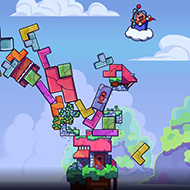
The physics engine in Tricky Towers does not forgive a rushed placement, not even by a single pixel of overhang. A block that looks seated can still carry enough imbalance to bring the stack down two pieces later, and the game never flags which one it was.
| Genre | Physics Puzzle / Building Simulation |
| Platform | Browser (HTML5) |
| Core Loop | Drop and rotate falling block pieces, stack them as high as possible without toppling |
| Objective | Reach maximum height while keeping the tower’s center of balance stable |
Stripped down, the core mechanic is simple: pieces fall one at a time, you rotate and shift them before they land, and every choice either keeps the tower’s weight centered or pushes it toward a lean. Beginners consistently treat each piece as an isolated decision instead of thinking about how it interacts with the pieces below it. A block placed dead center feels safe, but if the layer underneath was already leaning, that placement just adds weight to the wrong side.
Balancing Blocks Without Overcorrecting in Tricky Towers
The instinct most new players fall into is overcorrecting the moment they notice a lean, nudging the next piece hard toward the opposite edge. That almost always makes things worse, trading a small lean for a sharper one. The better habit is smaller, earlier corrections, made before a lean is even visible, paying attention to where the previous pieces actually settled.
Difficulty doesn’t come from faster falling pieces so much as accumulated risk. In the opening minutes, a stack of five or six pieces is forgiving, since there’s little height for a lean to amplify. Once the tower climbs past a dozen pieces, the same small misjudgment that was harmless early becomes the difference between stable and collapse.
- Long, flat pieces for spreading weight across a base
- Blocky, square pieces for stable center placement
- Angled or L-shaped pieces that force a deliberate rotation choice
One thing that only becomes obvious from playing several runs is the sound difference between a piece settling cleanly and one landed slightly off-balance; players who learn to listen for it correct before the visual lean is even noticeable.
Reading a Lean Before It Becomes a Collapse
Watching the silhouette rather than individual pieces separates players who recover from a bad drop from those who panic-stack on top of it. A slight lean is still recoverable with a counterweight piece; left alone for two or three more drops, it usually isn’t.
Why the Middle Stretch of a Run Feels Different
Once a run moves past its early, forgiving phase, the margin for error narrows, and that middle stretch is where most towers fall. Players who’ve spent time with the game describe this as the point a run either “locks in” or starts wobbling toward a topple.
Patience and Pace as the Real Skill in Tricky Towers
The temptation to drop pieces quickly and chase height fast is strong, especially once a tower feels stable. Slowing down during that stretch, rather than speeding up, is the advanced habit that separates consistent stackers from players who build a tall tower and lose it in the last few pieces.
Community talk around games like this leans on words like “topple” and “wobble” for the moment a stack goes from recoverable to lost, and there’s a shared understanding that a patient build usually outlasts a fast, greedy one. It’s also fair to say the controls can feel imprecise during quick rotations, a criticism players raise even while enjoying the core loop.
A player who favors flat, wide pieces early builds a more stable base but sacrifices height later, while a player who stacks aggressively trades that safety for a riskier climb. Recognizing which type of player you are shapes how each drop gets handled.
- Why does my tower keep falling even when it looks straight? A tower can look straight while carrying a slight weight imbalance from a few pieces back; the lean is often internal, which is why the settle sound and silhouette matter more than eyeballing straightness.
- How do you stack higher without losing control? Slowing the pace once a tower passes its early, forgiving height and making smaller corrective placements keeps it climbing without the sharp leans that cause a collapse.
- Is Tricky Towers hard to get consistent at? It takes longer to get consistent than to get one good run, since a lucky tall tower doesn’t teach the habits that a string of steady, moderate-height towers does.
Tricky Towers rewards patience more than speed, and that’s really the whole lesson hiding inside a simple stacking loop. A tower that climbs slowly, with small corrections made before a lean is even visible, will consistently outlast one rushed for a quick burst of height, and that gap between rushed and deliberate play is where the game actually lives.