
























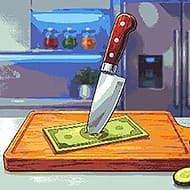
Slice To Meet You






What happens once you’ve unlocked every ingredient on the board in Slice To Meet You? That’s usually the second question new players ask, right after the first one: why does slicing carrots over and over feel this satisfying? The answer sits in how deliberately the game strips away pressure, leaving nothing but the rhythm of the cut and the slow climb of your kitchen’s earnings.
| Genre | Idle / Incremental cooking |
| Core loop | Slice ingredients for cash, reinvest in knives and kitchen upgrades |
| Fail state | None — no timers, no losing conditions |
| Customization | Knives, cutting boards, tables, plates, radio genres |
The Slicing Loop at the Heart of Slice To Meet You
Every ingredient that lands on the cutting board in Slice To Meet You earns a small amount of money the moment it’s sliced, and that money is the entire economy. There’s no timer counting down and no penalty for stepping away mid-session, which is unusual enough in the incremental genre that it gets mentioned constantly in player reviews. The loop rewards patience over reflexes: cut, collect, reinvest, repeat.
Beginners tend to make one predictable mistake early on. They dump every early payout into new ingredients instead of upgrading their knife first, and end up grinding through low-value produce far longer than necessary. A sharper knife cuts faster, which compounds earnings in a way that unlocking a new vegetable simply doesn’t match in the opening stretch.
By the time a player reaches the mid-tier ingredients, the pacing shifts. Earnings start climbing fast enough that decorations and radio unlocks feel like genuine rewards rather than side content, and that’s usually the point where the game stops feeling like busywork and starts feeling like a kitchen you actually built.
Choosing Knives as Ingredients Get Tougher
The knife system in Slice To Meet You is where the game’s only real strategy layer lives. Each blade has strengths tied to particular textures, and the same knife that breezes through soft produce early on will visibly slow down once tougher ingredients enter rotation. Knowing when a blade has outlived its usefulness, rather than just holding onto the first good knife you unlocked, is what separates players who stall out from players who keep climbing.
This is also where the community vocabulary kicks in. Players on forums talk about knife “breakpoints,” the moments where a given blade stops being efficient against a new ingredient tier and needs replacing. Recognizing a breakpoint before it slows your income is a skill the game never explicitly teaches you, and it’s one of the more debated aspects among players who otherwise agree the game is meant to be relaxing rather than difficult.
Advanced players go a step further and build a small rotation of two or three knives, swapping based on whatever ingredient currently makes up the bulk of their orders rather than sticking with a single all-purpose blade.
Decorating the Kitchen for Passive Bonuses
- Cutting boards each carry their own passive bonus, usually tied to slicing speed rather than raw earnings.
- Tables and plates stack additional multipliers, so the kitchen’s total bonus comes from combinations rather than any single item.
- Rustic decorations add smaller flat bonuses but are prized by players who care about how their kitchen looks as much as how it performs.
Casual players who log in for short sessions tend to prioritize whichever decorations boost passive income the most, while completionist players chase every cosmetic combination regardless of the numbers behind it.
Setting the Radio for the Kitchen’s Mood
An in-game radio lets players pick from jazz, tavern melodies, rock, hip-hop, pop, and electronic tracks, and switching genres mid-session is common among players who use Slice To Meet You as background music for other tasks. It’s a small touch, but it’s frequently cited as the reason players leave the game open far longer than the slicing loop alone would justify.
How do you unlock new ingredients in Slice To Meet You?
New produce unlocks automatically once your total earnings cross specific milestones, so there’s no separate currency to manage beyond the money slicing already generates.
Is there a way to speed up slicing without buying every knife?
Upgrading cutting boards and tables for their speed bonuses stacks with whatever knife is currently equipped, so players short on cash for a new blade can still meaningfully speed up their income through equipment alone.
Does the radio affect gameplay in Slice To Meet You?
No, the radio genres are purely cosmetic and exist to set the mood rather than provide bonuses, though players still treat picking a station as part of setting up their kitchen each session.
Slice To Meet You never asks players to rush, and that’s exactly the point: whether someone is chasing the next knife breakpoint or just letting jazz play over a growing pile of produce, the game keeps rewarding whoever sticks with the slice.