




















Spaghetti Celesti: Devour the Heavens










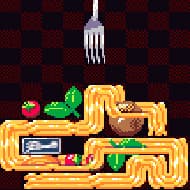
You watch a long strand of spaghetti drop toward the fork in Spaghetti Celesti: Devour the Heavens, turn it once to line it up with the pasta already waiting below, and realize a moment too late that the little foods riding along with it are about to land in the wrong place. That single second of panic is the heart of this falling-block puzzler. The game borrows an arcade rhythm everybody recognizes and swaps tidy rows for a tangled, edible mess.
| Genre | Falling-block puzzle |
| Platforms | Windows, macOS, Linux |
| Controls | Keyboard or controller |
| Typical session | A few minutes |
| Goal | Roll the perfect forchettata |
How a Forchettata Comes Together in Spaghetti Celesti: Devour the Heavens
Every round is built around the forchettata, a single forkful of spaghetti that should be as long as possible, rolled neatly, and generously garnished with little foods. The welcome message promises the most perfect forchettata you have ever eaten, and the game takes that promise seriously. Pieces of pasta and toppings fall in from above, and your job is to combine them into something that still looks worth eating instead of a pile of noodles.
The tutorial deserves your attention early in the game. It walks through the rules step by step, and skipping it is the fastest way to misread what the pasta wants from you.
Controls stay friendly. The keyboard works, and so does any gamepad, including Xbox and PlayStation controllers, so you can pick whichever feels better for quick rotations. A typical session lasts only a few minutes, which means a ruined plate costs very little and a second attempt starts almost immediately.
Where Beginners Tangle Their First Plate
Most newcomers treat the little foods as decoration and drop strands without thinking about what is riding along. The toppings are part of the puzzle because they have to end up tangled into the spaghetti, and a careless angle leaves them dangling or buried. Players who grew up on classic falling-block puzzlers tend to trust their muscle memory here and discover that a strand of pasta does not behave like a square.
- Rotating too late, so the strand lands at an angle that cannot be fixed
- Ignoring the toppings until the plate is already crowded
- Chasing length while letting the forkful turn into a knot
Some of the frustration is the game’s own doing. One player who enjoyed it overall noted that certain angles when spaghetti is combined did not feel right, which is worth knowing before you blame your own reflexes.
The learning curve is still short. One player described the controls as surprisingly intuitive, with the hang of it arriving after a few tries.
Reading the Reviews and Climbing Into Difficile
Results arrive as reviews, the way a restaurant would be judged, and the star rating is the number players compare with each other. One player reported reaching a 4.6 average across 15 reviews on Difficile before having to stop, and praised the scoring system along the way.
By the time you step up to Difficile, the habits from the tutorial need to be automatic. Rotation speed, angle choice, and the placement of toppings become much harder to ignore, and a sloppy plate shows up in the rating quickly.
The satisfying moment is easy to recognize once you have felt it: a long strand lands cleanly, the garnish sits where it belongs, and the forchettata finally looks like something a restaurant would serve.
Stacking Strategy in Spaghetti Celesti: Devour the Heavens
Advanced play starts with deciding the angle of a strand before it reaches the fork rather than correcting it during the drop. A clean connection is easier to stack on, while a rushed one forces you to spend the next strand repairing it.
Community chatter already points at deeper tricks. One player suggested the game should award a bonus for chaining forks into forks, a sign that people are hunting for combo routes before any official ones are spelled out.
Another commenter compared the game to WildSnakes, saying the ingredients tangled into the spaghetti add variety and challenge. Players who enjoy compact, smart arcade design will see why: a simple idea, a handful of moving parts, and enough depth to keep a few minutes interesting.
Questions Players Ask Before Their First Plate
- Can I use a controller? Yes. The game supports a keyboard as well as Xbox, PlayStation, and other gamepads, so you can choose whichever makes rotating strands easier. The tutorial introduces the controls before your first forchettata, so nothing has to be memorized in advance.
- How long does one session last? Plates are quick to finish, so a few rounds fit into a short break. Once you start chasing a better star rating on Difficile, it becomes easy to keep replaying for a cleaner forkful.
- Is the tutorial worth sitting through? Yes, since it covers how strands and toppings combine before the pressure starts. Skipping it means learning the same lessons the hard way, one ruined plate at a time.
Spaghetti Celesti: Devour the Heavens turns a few minutes of pasta stacking into a tense chase for the perfect forchettata. Learn the rotation in the tutorial, watch how the toppings tangle, and then carry the star rating from your first reviews into Difficile to see whether your plate still holds together.