






Doggy Don’t Care


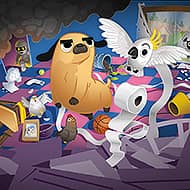
You grab a roll of toilet paper in Doggy Don’t Care and the hallway behind you turns into a long white ribbon. A few steps later Charlie plants his paws in oil, and suddenly the roof of his owner’s car is covered in tracks. Nobody is around to stop you, and that is exactly the point. This is a comedic 3D adventure about a small pug left home alone, and it treats making a mess as a perfectly reasonable way to solve problems.
| Genre | Comedic 3D adventure with sandbox and puzzle elements |
| Platforms | PC and Steam Deck |
| Players | Single-player |
| Levels | 4 |
| Goal | Earn Mischievous Badges from Charlie’s feathered friends |
Charlie and the Art of Adorable Chaos in Doggy Don’t Care
The setup could not be simpler. Charlie’s owner leaves, the house belongs to him, and the game hands you a whole list of ways to abuse that trust. The focus is mischief, not combat. You wander, pick up props, and find out what happens when a paw meets a pillow, a chair or a photo frame. Early in the game the lesson sinks in fast: almost everything in a room is there to be pushed, dragged, chewed or knocked over.
Movement is the base layer of the fun. Charlie runs through bright, rounded, cartoon-style spaces, so even a wrecked living room looks more like a toy box than a disaster zone. Fans of Untitled Goose Game will recognise the loop straight away: pick a target, cause trouble, admire the result.
Props do the heavy lifting. Toilet paper leaves a trail wherever Charlie goes, and oil turns his paws into stamps. Both examples show how the design works: whatever Charlie carries or steps in changes what he leaves behind, and that becomes the raw material for the puzzles.
Mischievous Badges and the Puzzles Behind Them
Chaos alone would get old, so Doggy Don’t Care gives it a purpose. Every level holds a batch of Mischievous Badges, and Charlie’s feathered friends hand them out when his shenanigans impress them. Each badge is effectively a puzzle, and each one depends on causing as much mayhem as possible with whatever Charlie can find nearby. That blend of open play and targeted challenges is what separates the game from a plain toy box.
Found items solve puzzles, so hoarding pays off. The props you will keep running into look like this:
- Toilet paper rolls that lay a trail behind Charlie wherever he walks
- Oil that leaves paw prints across the roof of his owner’s car
- Pillows, chairs and photo frames that reward a closer look
Beginners often treat badge hunting like a checklist and sprint from room to room. That backfires, because a badge usually wants a chain of small actions rather than one lucky grab. Slow down, look at what a prop can do, and ask what a bird would find funny. Completionists will be happy either way, since checking every pillow, chair and photo frame is basically the intended route.
Steam tags the game as a collectathon, and that fits. The badge count gives each level a clear finish line, but the route to it is entirely up to you. Some players clear a room in a tidy sweep, others let the zoomies decide, and both approaches work.
Four Levels Worth Tearing Apart in Doggy Don’t Care
Charlie gets four vibrant, interactive environments to run through. That sounds modest, and it is, but each one is built as a dense playground rather than a corridor to sprint down. The setting is ordinary domestic life scaled up for a dog, where a roll of toilet paper counts as a major discovery and a parked car counts as a canvas.
Nothing here is built around reflexes, so the challenge comes from noticing rather than surviving. By the time you are chasing the last few Mischievous Badges in a level, the hard part is remembering which corner you skipped. Small, clever nudges suit that pace far better than a hunt for a fight.
Dreams add a quieter layer. Charlie sleeps, his legs twitch, and you get to explore what he is dreaming about and uncover the hidden meaning behind it. Those sequences give the game a more thoughtful streak than the toilet paper jokes would suggest.
Pawjama Outfits and Other Detours from the Mess
The cosmetic side is bigger than it first appears. Charlie finds pawjama outfits as he explores, and the closet reaches from a giraffe to a unicorn to, heaven forbid, a cat. Each find gives you a reason to keep poking around after the obvious mischief is done.
The outfits arrive as a side effect of exploring, so the loop stays about curiosity. You are dressing a pug as a unicorn because you can, and that looseness is what draws people to mischief sims in the first place.
Doggy Don’t Care is also easy to hand to a younger relative. It is family friendly, single-player, and gentle enough that you can watch someone else play without wincing. Steam Deck support is verified as well, so a couch session on a handheld is realistic.
Where the Mischief Stays Gentle
Doggy Don’t Care will not suit everyone. A tight challenge, a combat system or a sprawling story are not on offer, so the pace stays very relaxed. Four levels make it a compact playground rather than a long campaign, and whether that reads as focused or brief depends on what you expect walking in.
The comedy also depends on your willingness to improvise. If you wait for the game to announce what is funny, you may stand in a room wondering what to do next. The badge puzzles supply direction, but the best moments come from trying odd combinations of props.
Comparisons to Untitled Goose Game are fair for tone. The difference is the setting and the toolkit: a house instead of a village, found-item puzzles, dream sequences and a wardrobe of costumes on top.
Questions Players Ask Before Starting Doggy Don’t Care
How many levels does the pup get to wreck?
There are four levels, each one a vibrant, interactive environment where Charlie can run around and collect badges. Every level is packed with Mischievous Badges and props to knock over, so the playtime feels larger than the count suggests.
What are Mischievous Badges and how do you earn them?
Badges are rewards handed out by Charlie’s feathered friends when his shenanigans impress them. Each one is a puzzle, solved with found items such as a toilet paper roll or a puddle of oil that lets Charlie leave a mess behind him.
Is it similar to Untitled Goose Game?
The tone is close, since both are about being adorably destructive with nobody stopping you. Charlie’s adventure is set inside a home, adds pawjama outfits and dream sequences, and organises the fun around Mischievous Badges.
Doggy Don’t Care works best when you stop hunting for the objective and start chasing the next bad idea. Charlie’s toilet paper trail, the oil-stamped car roof and a closet full of pawjamas are all reasons to poke into one more corner before the owner comes home.