


















Interdimensional Vending Machine













You sit cross-legged on the cold pavement near the Mall Entrance, watching strangers pass under flickering streetlights. Some drop a coin without even looking at you. Some say something that doesn’t sound entirely human. This is where every run of Interdimensional Vending Machine begins, and the opening ten minutes never quite prepare you for what the rest of the loop becomes.
| Genre | Survival, Interactive Fiction, Psychological Horror |
| Core Loop | Beg for yen, feed the vending machine, manage hunger and thirst |
| Currency | Yen |
| Win Condition | Reach one of the recognized true endings |
| Structure | Single-player, choice-driven, multiple branching routes |
Begging Near the Mall Entrance and Reading the Crowd
Coins in this game don’t come from a shop or a job. You get them by sitting down and waiting for pedestrians to notice you, and every passerby is a small gamble in itself. Most will ignore you outright, a few will drop a coin without comment, and every so often someone says a line that feels slightly wrong for a random stranger to say. None of this is explained directly, which is part of why new players tend to treat the early minutes as filler instead of the foundation they actually are.
Beginners usually rush this stage. They grab whatever small amount of yen they’ve collected and dump it straight into the machine, hoping for something useful, instead of saving toward a specific amount tied to a specific item code. That impatience is the single biggest reason first runs end in an early starvation warning rather than anything close to a proper ending.
Early in the game, patience at the Mall Entrance matters more than any single item from the machine. Completionist-minded players in particular tend to track exact coin totals from each passerby, since knowing which amounts repeat makes the whole begging phase far less random than it first appears.
What Interdimensional Vending Machine Actually Dispenses
Once you’ve got yen, the machine itself becomes the real center of the game. Insert a specific amount and it spits out something tied to that number, and the ranges are consistent enough that players have mapped a good chunk of them. Small amounts between 1 and 10 yen tend to give apple seeds, 50 yen almost always returns exactly 50 seeds, and 100 yen opens up a much wider pool that can include anything from drinks to raw flesh, healthy or otherwise.
Push into the higher and stranger brackets and the machine starts referencing the wider SCP-inspired universe it borrows from. Certain totals can produce SCP-682 outright, a sealed box with a red button hints at SCP-131, and a stray Polaroid found nearby points toward SCP-354. A can labeled Diet Ghost, tied to SCP-2107, is one of the more memorable pulls simply because of how mundane its packaging looks next to what it implies.
The 135 to 147 range leans grim, dispensing things like Leech Cake, dirty water, or an Essential Water Bottle depending on the exact number used, while 176 yen gets you a full centipede skewer and 179 or 201 tends toward a spoiled sandwich or a cockroach skewer. Players in the community refer to this whole process as farming item codes, and once you understand the pattern, the machine stops feeling random and starts feeling like a system you can actually work.
- 1–10 yen: apple seeds, small quantities
- 50 yen: a fixed 50 apple seeds
- 100 yen: mixed drinks, flesh, and general items
- 135–147 yen: Leech Cake, dirty water, Essential Water Bottles
- 150 yen: cola cans
- 176 yen: a centipede skewer
- 179 / 201 yen: a spoiled sandwich or cockroach skewer
Hunger, Thirst, and the Cost of Every Choice
Nothing you pull from the machine is free once it’s in your hands. Every item ties into hunger, thirst, or both, and choosing to eat something is always a small bet on what it will do to your body. Some items are quietly generous, restoring a meter without any visible side effect. Others chip away at something you didn’t know was being tracked until the change becomes visible.
The honest, frequently discussed problem with this system is that early items give almost no warning about what they’ll actually do. A newcomer eating a random pull has no way to distinguish a helpful item from one that starts a transformation, and the community generally agrees this opacity is intentional rather than a bug, even if it frustrates first-time players.
By the time you reach your first mutation, the loop has already taught you to read item names with suspicion. That shift in mindset, from hungry to cautious, is the moment most players say the game actually clicks.
The Apple Seed Route and Other Transformations
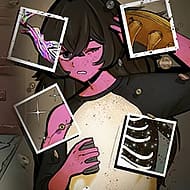
Feeding the girl nothing but apple seeds throughout an entire run leads to one of the more visually dramatic outcomes in the game. Using only 1, 5, 10, and 50 yen to keep the seed supply going, you watch her slowly grow more powerful over roughly 45 items, until she shifts into a glowing eldritch form with multiple arms, glowing white eyes, and a visible spine and ribcage.
There’s also a rarer branch, the Hollow Bride form, which triggers on a low chance from a specific food pull rather than a deliberate diet, catching a lot of players completely off guard the first time it happens.
Transformations like these are what most streamers clip and what most forum threads reference when they talk about the game, since they’re the clearest payoff for sticking with a single, deliberate item strategy.
Rebirth, Ascension, and the Rotten Path in Interdimensional Vending Machine
Once a run reaches a certain point, rebirth becomes available, letting you reset key progress and choose ascension to unlock a route that wasn’t accessible before. This is the mechanic that turns the game from a single strange playthrough into something with actual replay structure.
The Rotten path runs in the opposite direction from the Apple Seed route. Feeding on Moldy Sandwiches and similar rotten-tagged items pushes you through a series of danger stages, each one visibly worse than the last, until the final stage unlocks its own achievement.
Advanced players will often farm a known yen value repeatedly once they’ve confirmed it reliably returns a rotten item, since the icon on the drop is what actually matters, not the specific food name attached to it.
Reaching the Police and Starvation Endings
As of the current build, Police and Starvation are the only two outcomes classified as true endings, meaning they’re the ones that actually stop the run rather than looping you back into another cycle. Starvation is the blunt one: ignore hunger and thirst long enough and the game ends without ceremony.
Police triggers through repeated danger alerts, usually stacked up from rotten or otherwise flagged items eaten in sequence at the Mall Entrance.
Reaching 1,000,000 total yen spent is its own milestone tied to the achievement list, but players are warned to watch that counter carefully, since hitting it unexpectedly resets progress rather than rewarding it outright.
How do you get the Apple Seed ending in Interdimensional Vending Machine?
You stick to apple seeds exclusively, buying them with 1, 5, 10, and 50 yen purchases and avoiding every other item type. Around 45 seed items in, the transformation into the glowing multi-armed form triggers automatically.
What happens if you feed the girl too much rotten food?
She progresses through a series of visible danger stages tied to Moldy Sandwiches and similarly tagged items. Push far enough and you’ll eventually reach the final Rotten stage and its associated achievement, though repeated danger alerts can also lead straight into the Police ending.
How do rebirth and ascension work?
Rebirth resets certain progress once a run reaches a qualifying point, and choosing ascension from there unlocks a route that was previously locked off. It’s the main way players access content beyond a single linear playthrough.
Interdimensional Vending Machine rewards the kind of patience most survival games punish, turning a simple coin slot into a system worth mapping out yen by yen, and few moments capture that better than watching the Hollow Bride form appear on a pull you never planned for.