











My Fire Is Bigger Than Yours





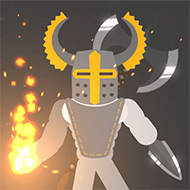
You toss a single log onto the coals and nothing dramatic happens — the flame barely flickers, the counter ticks up by a fraction, and that’s the whole point of My Fire Is Bigger Than Yours in its opening minutes. This is a physics-based incremental game where every object you throw actually reacts to the fire underneath it, and the early game is deliberately slow so you notice what’s burning and why.
| Genre | Incremental / Physics Sandbox |
| Structure | 3 escalating arcs |
| Core Loop | Feed the fire, survive the Rain, unlock upgrades |
| Final Goal | Grow bigger than the Sun |
Spawners and the First Fifteen Minutes
The spawners are your only tool at the start, and each one flings a limited object type toward the flame at a fixed angle. Players quickly learn that a spawner pointed too high wastes fuel by overshooting the pit entirely, which is the first mistake almost everyone makes in this game.
Rearranging a spawner mid-run and watching its live trajectory line is a small detail, but it’s the moment the mechanic actually clicks — you stop guessing and start aiming with intent.
By the time your fire clears its first size threshold, you’ve usually placed three or four spawners without thinking much about synergy. That changes fast once the upgrade tree opens up.
Reading the Upgrade Tree in My Fire Is Bigger Than Yours
Nodes on the upgrade tree unlock based on proximity to ones you’ve already claimed, so a run built around one fuel type opens different branches than a run spread thin across several. Some players chase lightning early because it chains between burning objects and creates cascading reactions that can double your growth for a few seconds.
Others prioritize explosion-based nodes, which throw fragments outward and can accidentally ignite spawners you didn’t mean to trigger yet — a chaotic but often profitable accident.
There’s no single correct branch, and that’s a point players actually argue about in the discord: some think the lightning path is overtuned compared to slower cascading builds.
Surviving the Rain
- Fuel burns faster during the Rain, so stockpiling flammable objects beforehand matters more than reacting in the moment.
- Spawners with wider trajectories tend to keep feeding the fire even when visibility drops.
- Runs that specialize in one flammable type often struggle here, since the storm punishes narrow builds.
The Rain is where casual players usually stall out for their first several attempts, and it’s genuinely a wall — not a scripted difficulty spike but a consequence of whatever build choices you made twenty minutes earlier.
What happens once the Rain ends in My Fire Is Bigger Than Yours?
The fire enters its next threshold and the Sun becomes visible above the pit, which is the game’s way of signaling that passive growth is over and active building begins.
Do explosion nodes work well with lightning builds?
They can, since fragments from an explosion give lightning more targets to chain between, though several players note the combination gets visually chaotic and can slow the game on weaker hardware.
Is there a way to recover from a bad spawner layout?
Yes — spawners can be flipped and repositioned at any point, so a layout that underperforms during the Rain can still be rebuilt before the next threshold.
My Fire Is Bigger Than Yours rewards the kind of player who tinkers with spawner angles instead of accepting the first layout that works, and that habit is exactly what gets a fire past the Rain and within reach of the Sun.