




















Particle Life






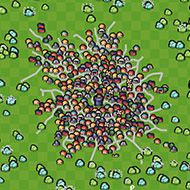





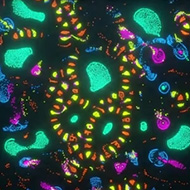
Red particles chase green ones across the screen, not because anyone programmed a chase behavior, but because a single line of code makes red attracted to green while green is repelled by red — and that asymmetry alone is enough to produce something that looks unmistakably alive. Particle Life is a simulation, not a traditional game, built around simple attraction and repulsion rules between colored particle species.
| Genre | Artificial life simulation |
| Core Mechanic | Attraction/repulsion forces |
| Platforms | Browser, mobile, desktop builds |
| Origin | Inspired by Conway’s Game of Life |
How Attraction and Repulsion Actually Work
Each particle species has its own relationship to every other species, and crucially, that relationship doesn’t have to be mutual. Red can chase green while green flees red, and that single asymmetric rule — repeated across a handful of colors — produces swirling clusters, orbiting formations, and chasing packs that emerge without anyone directly designing them.
A global friction setting keeps particles from accelerating forever, and a short-range repulsion prevents particles from collapsing into a single point, functioning almost like the degeneracy pressure that keeps real matter from imploding under its own gravity.
Presets and the Search for “Life-Like” Behavior
Most implementations of Particle Life ship with presets tuned to produce specific emergent behaviors, but the real appeal for most players is adjusting the underlying force matrix themselves and watching what kind of structure emerges. Community discussion consistently circles the same open question: what parameter combinations actually count as “life-like,” since the term resists a clean definition even among people who’ve spent hundreds of hours tweaking the rules.
Early experiments tend to produce chaotic, formless motion. By the time you’ve tuned attraction and repulsion values across several species pairs, distinct self-organizing clusters typically start appearing — and that transition point is what keeps people tweaking sliders for hours.
The Hand of God Tool
Some versions of Particle Life include an interactive “Hand of God” feature that lets players herd particles by swiping or beckon them by pressing, giving direct influence over a system that otherwise runs entirely on its own rules. This tool turns passive observation into something closer to guided experimentation.
Space Partitioning and Performance
Because every particle theoretically interacts with every other particle, naive implementations scale terribly as particle counts climb. Browser-based versions typically solve this with space partitioning, dividing the simulation into regions so particles only calculate forces against nearby neighbors rather than the entire population.
3D Versions and Extended Properties
Some Particle Life projects extend the core two-dimensional rules into three-dimensional space, adding properties like mass, energy, and an energy transfer threshold that determines when one particle can pass momentum to another — a level of depth that goes well beyond the original two-rule concept.
What makes Particle Life different from a normal physics simulation?
Standard physics simulations follow uniform, symmetric rules for every object, while Particle Life deliberately allows asymmetric, per-species relationships, which is exactly what produces its unpredictable, organism-like behavior.
Can you save custom particle configurations?
Support varies by version — some browser and mobile builds lack save functionality entirely, a limitation players frequently mention when a particularly interesting configuration emerges and can’t be preserved.
Why do particles sometimes just scatter instead of forming clusters?
Poorly balanced attraction and repulsion values tend to produce chaotic scattering rather than structure, which is why tuning the force matrix carefully is the actual skill behind getting compelling emergent patterns.
Particle Life proves something genuinely strange about complexity: you don’t need intelligence, goals, or even that many rules to get behavior that reads as alive. Watching a cluster of particles chase, orbit, and split apart on screen is enough to make anyone question just how much of “life” really comes down to a handful of attraction and repulsion values.