


















RAGDORE – Euphoria Ragdoll Fight









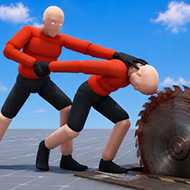
You drop your ragdoll straight into a spinning shredder just to see what happens, and what happens is exactly why RAGDORE has built the reputation it has: no goal, no checklist, just a fully simulated body reacting to whatever punishment you throw at it next.
| Genre | Physics sandbox, action |
| Status | Early Access |
| Players | Single-player |
| Core focus | Ragdoll damage and dismemberment |
The Damage System at the Center of RAGDORE
There is no story and no objective screen telling you what to do next. Instead, the entire game revolves around a character whose body responds in real time to whatever hazard it meets, whether that’s a crusher, a spike pit, or a launcher flinging it across a map. Movement genuinely changes based on injury, so a character that just lost a leg to a trap moves nothing like one still fully intact.
New players often expect the ragdoll to behave predictably once damaged, the way many simpler ragdoll toys do, and get caught off guard by how specifically each limb loss changes balance and control.
Crawling, Stumbling, and Adapting Mid-Session
Once legs break, walking turns into stumbling, and once arms are gone entirely, crawling becomes the only remaining option for getting a body from one hazard to the next. This shifting control scheme is the part players in the community reference most when explaining why RAGDORE stays interesting longer than a typical physics toy, since no two damage states control quite the same way.
Experimentation-focused players tend to chain hazards deliberately, sending a ragdoll from a trampoline straight into a crusher just to watch the combination play out, while players who enjoy a slower pace often explore individual maps first before testing destruction combinations.
Maps and Hazards Players Actually Talk About
Community discussion frequently centers on specific maps, including a small city area with sewers where players have reported unexpected jumpscare-style moments, and a more abstract polygon-styled level that plays very differently from the city setting. Trampolines, shredders, spike pits, and launchers show up across these maps in varying combinations, and figuring out which hazard produces the most chaotic reaction is a big part of what keeps sessions going.
One detail players consistently bring up is restarting a ragdoll after a particularly messy destruction sequence now requires pressing the restart key twice rather than once, a small change that came directly from community feedback during Early Access.
What Beginners Get Wrong in RAGDORE
The most common early mistake is treating every hazard as a one-off gag rather than something that stacks. A ragdoll that already lost an arm to a shredder reacts very differently to a launcher than a fully intact one would, and players who ignore that compounding damage tend to find later interactions less interesting than they could be.
The lack of any set goal is itself a divisive point among players. Some find the total absence of objectives freeing, while others wish there was at least a basic challenge mode layered on top of the sandbox to give repeated sessions more direction.
Community Feedback Shaping Early Access
The developers have been explicit that community input drives which features get added next, and with 1 package currently listed on Steam alongside the base release, the game is still expanding its content roughly a year after its original release. Players requesting split-screen or multiplayer support show up constantly in discussions, even though the current build remains strictly single-player.
- What is the goal in RAGDORE? There isn’t one; the game is a physics sandbox built entirely around experimenting with damage, dismemberment, and hazards like crushers and shredders rather than working toward any win condition.
- Does damage in RAGDORE actually affect movement? Yes, losing legs causes stumbling, losing arms forces crawling, and the character’s balance and control shift noticeably based on exactly which body parts remain functional.
- Does RAGDORE have multiplayer or split-screen? Not currently; the game is single-player only, though players have repeatedly requested split-screen and multiplayer options in community discussions.
RAGDORE turns a body falling apart into the entire point of playing, and once you’ve watched a ragdoll crawl its way out of a shredder with nothing left but stubborn momentum, it’s clear the polygon level and the small city map were built with exactly that kind of chaos in mind.