



















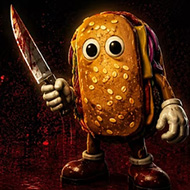
Serve or Die











What happens when a sandwich order stops being just a sandwich order? That’s the question Serve or Die keeps circling back to, night after night, as you work alone behind the counter of a small late-shift sandwich shop and watch ordinary transactions curdle into something you can’t quite explain.
| Genre | Psychological horror simulation |
| Setting | A late-night sandwich shop |
| Perspective | First-person, single-player |
| Core Objective | Prepare orders and survive an increasingly unstable shift |
The Night Shift Loop at the Center of Serve or Die
The core loop reads simple on paper: take an order, prepare it, hand it over, repeat. Order accuracy matters early — get a sandwich wrong and a customer’s reaction feels mildly annoying at worst. But the game uses that mundane repetition deliberately, lulling you into a rhythm before quietly breaking it. Once the shop’s atmosphere starts shifting, that same simple loop becomes something you’re actively dreading returning to.
Beginners tend to focus purely on speed and efficiency, treating the shop like a straightforward time-management game. That instinct isn’t wrong exactly, but it misses the point — Serve or Die wants you paying attention to who’s standing on the other side of the counter, not just what they ordered.
The VHS-inspired visual filter reinforces that unease constantly, warping the edges of the screen just enough that you start second-guessing what you actually saw in a customer’s face a second ago.
Reading Customers Instead of Just Serving Them
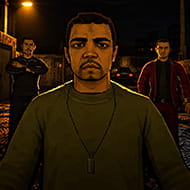
Most players describe the same turning point: a customer who seems slightly off, whose dialogue doesn’t track with a normal late-night order, whose presence makes the counter feel smaller. Some of these customers behave completely normally the entire interaction. Others clearly know things about the shop, or about you, that a stranger walking in off the street shouldn’t.
That uncertainty is the game’s real engine. You can’t reliably tell in advance which category a given customer falls into, so caution becomes a constant low-level cost rather than a reaction to an obvious threat. Community discussion around Serve or Die frequently centers on which specific customer lines are the first genuine tell that something’s wrong, since the demo doesn’t telegraph it loudly.
Players who favor careful, observant playstyles tend to slow down and study dialogue closely, while players chasing efficient runs often miss early warning signs entirely because they’re heads-down on prep work instead of watching the counter.
What the Tapes Reveal Once the Shift Turns
Scattered throughout the shop are fragments of the VHS aesthetic made literal — tape-glitch moments that interrupt gameplay and hint at what’s actually happening beneath the surface of a routine night shift. These sequences don’t explain themselves outright, which is part of why players keep replaying to piece together what they missed the first time through.
By the time you’re several orders deep into a shift, the line between a genuinely strange customer and a glitch in the presentation starts blurring on purpose. That’s a deliberate design choice, not a bug, and it’s the detail longtime horror fans bring up most when recommending the game to others.
Why the Ending Divides Players
Because Serve or Die is still early in its release cycle as the first entry in a planned larger experience, the current ending leaves several threads openly unresolved. Some players find that restraint effective, arguing it fits the tape-glitch storytelling style perfectly. Others find it frustrating after building up so much dread across a single shift with no clear payoff.
That disagreement shows up constantly in comment sections and it’s worth going in with the expectation that this is a first chapter, not a closed story — the shop’s mysteries are set up to continue rather than resolve.
Whether the tapes hold hallucinations, real threats, or something in between remains genuinely ambiguous after one playthrough, and multiple endings tied to how carefully you read customers during the shift are the main reason people come back for a second run.
Serve or Die turns a sandwich counter into one of the tensest spaces in recent horror games, and once you’ve clocked in for a shift and watched the tape-static creep into the corners of the shop, handing over the next order never feels as safe as it did five minutes earlier.