














Ritter & Rotwein
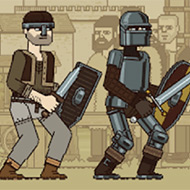




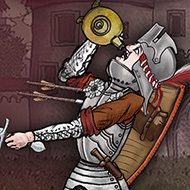
You step onto sun-bleached sand still shaking off the tumble that ended your last bout, shield dragging low as the crowd noise swells. That entrance sums up Ritter & Rotwein — a scrappy, physics-driven duel where footing and momentum decide fights as often as raw damage, and a clean hit sends a fighter cartwheeling before the pain even registers.
| Genre | Physics-based arena combat |
| Setting | Ancient-world gladiator arenas |
| Game Modes | Career, Arcade, Quick Fight, Local Multiplayer |
| Core Mechanic | Ragdoll-driven melee dueling |
Ritter & Rotwein and the Physics That Makes Every Hit Look Wrong
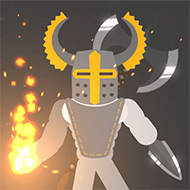
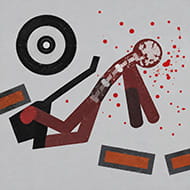
Every gladiator is a loose set of limbs, not a fixed animation, so a solid strike sends an arm flailing or a body spinning off-balance. This kind of game rewards reading weapons over reflexes: a sword swings fast and short, a spear throws for range, heavier weapons hit harder but recover slower.
Beginners button-mash and hope the flailing works out. Players who win consistently watch balance and weight, timing a strike for when an opponent is already off-center.
The honest, divisive part regulars bring up constantly: physics sometimes decide a fight more than skill does. A lucky shield bounce can end an even match, and that's either the funniest thing in Ritter & Rotwein or the most frustrating, depending which side you're on.
Reading the Two Combat Stances
Each gladiator switches between two stances, each with its own directional attacks, reach, speed, and power. One favors quick, close-range trading; the other trades speed for a heavier hit.
Early on, one stance is usually enough to win. Once heavier weapons appear in career mode, refusing to switch mid-fight starts costing fights, since a slow heavy stance gets outranged by a spear.
Watching two players trade stance switches in local multiplayer is where the system clicks. It stops looking like spam and starts looking like a real read on the other fighter.
Career Mode: Fame, Gold, and the Stats That Actually Matter
Every career win pays gold and fame, spent on weapons, armor, or stat upgrades to Strength, Health, Charisma, Willpower, and Looting. Health and Strength are the obvious early picks, since a fighter who dies in two hits never uses anything else.
Looting quietly becomes a strong long-term pick, raising what you earn from future wins. Regulars recognize the stumble right before a finishing blow, and the flat thud when someone gets knocked off a platform edge.
Players who like slower, methodical progress gravitate toward career mode because of this stat spending. Each bout ends up feeling like a small budgeting decision as much as a duel.
Arcade Runs and Why Ritter & Rotwein Gets Harder Fast
Arcade mode strips away the stat shopping and lines up consecutive fights, difficulty climbing steadily. There's no career-style safety net — one bad read against a heavy-weapon opponent can end a run that had been going smoothly.
The difficulty spike partway through a run is a debated point among regulars. A couple of matchups can feel noticeably harder than everything that came before them.
By the time an Egypt or Macedonia arena shows up, most players have already learned to respect stance switching. Ignoring it against a faster opponent gets punished fast.
- How do the two stances work in Ritter & Rotwein? Each gladiator carries two stances with different reach, speed, and power. Switching mid-fight answers a faster opponent with reach or a slower one with raw power.
- Which stats should you upgrade first in career mode? Health and Strength keep a fighter alive long enough to use anything bought, while Looting pays off through better gold from wins.
- Is arcade mode harder than career mode? Arcade removes career's safety net and stacks fights with climbing difficulty, so one bad read can end a run. Career lets a rough fight get absorbed by equipment bought beforehand.
Ritter & Rotwein isn't trying to be a clean, fair fighting game. It's a wobbly, physics-driven scrap where a Looting stat upgrade or a well-timed stance switch matters as much as raw skill, and that unpredictability is why regulars keep coming back for one more bout.