























Battle Of Dots : The Last Stand







What happens when you throw every dot you have at the first neutral cell in Battle Of Dots : The Last Stand, before your economy can support it? You take the cell, then watch production stall as the enemy probes your weak border.
Battle Of Dots : The Last Stand and the Cell-Capture Loop
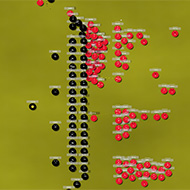
The loop is simple to describe, harder to execute. Each cell generates dots on its own, and you drag a line from a cell you control to a neighbor to send your army across. A cell falls once thrown dots outnumber its defenders.
Towers change the math. A captured cell can become a defensive tower that punishes attackers without overwhelming numbers, and choosing what to fortify is the real strategy.
The AI counters your moves instead of acting on a timer, so every attack draws a response elsewhere. Players watching only one move lose cells they stopped watching.
Reading the Arena Before You Commit
Scouting matters more than it looks like it should in a game this minimalist. Cell size tells you roughly how many dots sit inside, and attacking without checking turns a rush into a wasted army.
Balancing offense and defense is the constant pressure point. Push too hard and your back line sits undefended; turtle too long and territory decides the match.
- Neutral cells taken early generate compounding value for the round.
- Undefended cells near a contested border are the first ones tested.
- A tower upgrade on a front-line cell often blunts an attack that would otherwise cost the cell.
Where Battle Of Dots : The Last Stand Punishes Greed
Overextension is the most common way players lose a match they were winning. Cells taken fast start empty and need time to rebuild, leaving new ground soft as the enemy counter-attacks.
Some players find the AI’s counter-timing too convenient, striking your weak point almost the instant it opens. Fair complaint, but it keeps matches unpredictable.
Solo Runs Against the AI Versus Playing a Friend
Against the AI, matches settle into a rhythm you can study and beat with better timing. A friend removes that predictability, since a human bluffs toward one border while massing dots to hit elsewhere.
Community talk circles the same terms — dot-stacking for hoarding an army instead of spending it, cell-sniping for taking an undefended cell the moment its owner looks away.
- Is Battle Of Dots : The Last Stand better played cautiously or aggressively? Neither wins consistently. Strong players secure neutral cells fast, then fortify whatever border the AI keeps probing.
- How do towers work in Battle Of Dots : The Last Stand? A tower is a cell upgraded to defend itself, far harder to flip without a large army.
- Can you play Battle Of Dots : The Last Stand against another person instead of the AI? Yes, a mode for challenging another player exists, and it plays differently since a person bluffs.
Battle Of Dots : The Last Stand rewards the same instinct every time: take a cell you can hold, not just one you can reach, and watch your weakest border as closely as your newest tower.