
















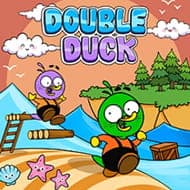
Double Duck









Two ducks share one leash-length of space at all times in Double Duck, and that single constraint does more design work than most puzzle-platformers manage with an entire toolkit of mechanics. Built for actual Game Boy Color hardware, this compact puzzle-platformer proves how far a genuinely novel movement idea can carry a game once the level design commits to it fully.
| Genre | Puzzle-Platformer |
| Platform | Game Boy Color |
| Levels | 11 |
| Core Mechanic | Two linked characters at a fixed distance |
Mars, Phobos, and the Fixed Distance Between Them
You control Mars, the green duck, and Phobos, the purple duck, simultaneously — and the two are permanently tethered at a fixed distance from one another. That distance never changes, even when one duck ends up suspended in mid-air with nothing beneath it, which is exactly the kind of situation the level design starts exploiting almost immediately.
Beginners tend to treat Phobos as a passive follower at first, moving Mars around and letting the second duck trail along for the ride. That instinct falls apart quickly once levels start requiring Phobos to hold position in open air while Mars does the actual platforming, using their shared tether as a literal anchor point rather than a limitation to work around.
The core rotation input — spinning Phobos clockwise around Mars using the B button — sounds simple in isolation but becomes the entire vocabulary of the game’s puzzle logic within the first couple of levels.
Rotating Through Walls in Double Duck
What makes the rotation mechanic distinctive is that Phobos can pass straight through walls and solid terrain while circling Mars, something most puzzle-platformers would treat as an exploit rather than a core feature. Here, it’s the whole point — later levels are built specifically around using that wall-phasing rotation to reach switches, ledges, or item pickups that would otherwise be completely inaccessible.
- Early levels teach the rotation input in isolation, with wide open spaces and no real time pressure
- Mid-game levels start combining rotation with traditional jumping, requiring precise timing between the two inputs rather than treating them as separate systems
- The later stretch of the 11-level campaign layers moving hazards on top of the rotation puzzles, demanding the kind of spatial planning that separates players who’ve internalized the mechanic from those still thinking of the ducks as one unit
By the time you reach the game’s harder stages, the wall-phasing rotation stops feeling like a trick and starts feeling like the only sensible way to think about movement — a shift several players have described as the point the game genuinely clicks.
Where First Attempts Usually Stall
The most common beginner mistake is trying to solve every obstacle with Mars alone, ignoring Phobos’s positioning until it’s forced by the level layout. Since the two ducks are always exactly the same distance apart, planning a route almost always means thinking about where both characters will end up simultaneously, not just where the lead duck needs to go.
A second common stumble happens around suspended-Phobos puzzles, where players instinctively try to move Mars toward solid ground to “rescue” Phobos rather than trusting the fixed distance to hold. Community feedback consistently flags this section as the moment the game teaches its most important lesson: the tether isn’t a problem to solve, it’s the solution itself.
Precision matters more than speed throughout — one small miscalculation with the rotation timing near a hazard can undo several careful steps of positioning in an instant.
Frequently Asked Questions
How many levels does Double Duck have?
The full release contains 11 levels, building from isolated rotation tutorials in the early stages to combined rotation-and-jumping puzzles layered with hazards by the back half of the campaign.
Can Phobos really pass through walls while rotating?
Yes — rotating Phobos clockwise around Mars lets it phase through solid terrain, and this wall-crossing behavior is the mechanic nearly every late-game puzzle is built around rather than a bug to avoid.
Does Double Duck support achievement tracking?
It integrates with RetroAchievements, giving players a way to track completion milestones across the 11-level campaign much like other homebrew titles built for the same hardware.
Double Duck earns its puzzle-platformer label the hard way, by building an entire campaign around one idea — the fixed tether between Mars and Phobos — and refusing to pad that idea out with unrelated systems. Eleven tightly designed levels later, rotating a duck through a solid wall stops feeling like a workaround and starts feeling like the most natural move in the game.