

















Demon Bluff


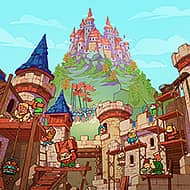






In Demon Bluff you start every round with a row of facedown cards, ten health, and no idea yet which of the villagers arranged in front of you are lying straight to your face. That opening uncertainty is the entire game, and it never really goes away no matter how many villages you clear.
| Genre | Single-player social deduction puzzle |
| Starting Health | 10 |
| Damage Per Mistake | 5 |
| Standard Mode Length | Up to Village 12 |
Reading Roles Like the Lover and the Enlightened
Every character card gives you a piece of information when revealed, but only Good roles give it honestly. The Lover tells you how many evil players sit beside them, the Enlightened points toward the nearest evil player’s direction, and the Gemcrafter simply names one player as good. None of this means anything in isolation — the puzzle is cross-referencing these claims until contradictions surface, the way a Blood on the Clocktower table would work out a storyteller’s lies without a storyteller present at all.
New players tend to trust the first smooth-sounding claim they flip, which is exactly the habit Demon Bluff punishes. Evil characters bluff by pretending to hold a Good role, and Corrupted characters lie outright even when their ability would normally work, meaning a Corrupted Enlightened will point you confidently in the wrong direction with the same certainty a genuine one would use.
Community guides repeatedly point to duplicate roles as the clearest tell: since most roles only exist once per village, seeing two identical roles almost always means a Doppelganger or a bluffing evil card is in play. Puzzle-focused players describe hunting for these duplicates as the fastest way to crack an otherwise confusing early board, since it narrows the suspect pool before you’ve even started cross-checking claims.
Why Executions Cost More Than They Look Like
You’ve got 10 health, and every wrong execution or fatal misread costs 5, which means a single village realistically allows only two real mistakes. That math shapes how careful players approach every dagger click, especially once the puzzles introduce more roles and the contradictions get harder to trace back to a single liar.
Logic-puzzle enthusiasts describe this scarcity as the reason Demon Bluff feels tighter than typical social deduction formats — there’s no group discussion to fall back on, no bluffing your way through a bad read socially. It’s just you, the cards, and whatever contradictions you can find, which is exactly the appeal for players coming from solo logic games rather than tabletop social deduction.
Players optimizing for score rather than just survival face an extra layer of pressure here, since Standard Mode’s scoring rewards fewer flips as well as fewer deaths — clicking every card just to gather information is safe but costly, so efficient runs require deducing as much as possible from a smaller set of revealed cards.
Standard Mode Versus Deckbuilding
Standard Mode runs a fixed progression up through Village 12, with scoring rewarding fewer deaths and fewer unnecessary flips over noisy guessing. Deckbuilding mode changes the approach entirely, letting you draft which characters go into the pool before facing a multi-part run that escalates in complexity as you go, layering roguelike deckbuilding on top of the same core deduction logic.
Players who prefer clean, repeatable puzzle-solving tend to stick with Standard Mode, while deckbuilders gravitate toward drafting specific role combinations to stress-test their deduction skills against harder setups. That divide shows up clearly across Discord and Reddit discussion, where Standard Mode players trade optimal-solve screenshots and Deckbuilding fans compare which role pools produce the nastiest lie chains.
Because Deckbuilding mode lets you choose which roles are even possible in a given run, it also changes how you read the board — a village drafted without any Doppelgangers removes an entire category of duplicate-role confusion, which experienced players sometimes exploit deliberately to sharpen their read on the remaining lies.
Escalating Villages and New Villagers
Early villages ease you into a handful of straightforward roles, but by the time you reach the later stages, the roster expands with more complicated abilities and more convincing lies. This gradual unlock structure is one of the more debated aspects of the game — some players want harder roles introduced earlier, while others appreciate the ramp giving them time to internalize the core logic first.
As you climb toward Village 12 in Standard Mode, the number of roles active at once increases enough that a single Corrupted card can chain false information across two or three other claims, which is where a lot of otherwise confident players hit their first real wall. Community threads specifically flag this stretch as where casual solving stops working and deliberate cross-referencing becomes mandatory.
New villager roles introduced later in a run tend to interact with earlier ones in ways the game never explicitly explains, so players end up building their own mental glossary of interactions — the kind of unofficial rules knowledge that circulates through guides rather than an in-game tutorial.
- What happens if two cards show the same role in Demon Bluff? Since most roles are meant to be unique, a duplicate almost always signals a Doppelganger copying an existing role or an evil card bluffing as that role, and cross-checking both cards’ other claims usually reveals which one is lying.
- How many mistakes can you survive in a single village? With 10 starting health and 5 damage per wrong execution or misread, you can typically absorb two serious errors before losing the round, which is why efficient players try to solve rather than guess their way through ambiguous boards.
- Is Demon Bluff more like a deckbuilder or a pure puzzle game? It’s both — Standard Mode plays as a straightforward deduction puzzle up through Village 12, while Deckbuilding mode adds roguelike progression and card drafting on top of the same core logic, letting you shape which roles you’ll have to untangle.
Whether you’re chasing a clean Standard Mode clear through Village 12 or drafting your own roster in Deckbuilding mode, Demon Bluff keeps coming back to the same tense question every Gemcrafter or Doppelganger forces you to ask: who’s actually telling the truth this time.