










La Madriguera


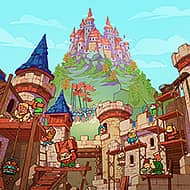



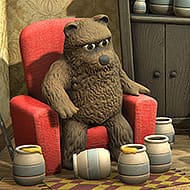
You nudge the mouse a few pixels to the left, and across the den a stack of cushions barely shifts — but it’s enough. The bear’s paw grazes the edge of a rug, something wobbles, and for one heartbeat you think the whole arrangement is about to collapse in exactly the way you need it to. That’s a typical minute in La Madriguera, a physics puzzle built around a single stubborn premise: the bear will not get up, no matter how close the cake gets.
| Genre | Physics puzzle |
| Controls | Mouse only — click, drag, release |
| Playable character | A bear seated in an armchair |
| Objective | Deliver a slice of chocolate cake into the bear’s paw |
The Paw, the Cake, and the Whole Point of La Madriguera
Most puzzle games hand you a character to move around a level. La Madriguera flips that arrangement entirely. You never walk, jump, or climb — you control a single paw, and everything you do happens through objects that are already sitting in the den. Chairs, lamps, side tables, and loose cushions all become tools the moment you drag them, and the cake itself never moves unless something else nudges it first. The bear stays exactly where he started, arms folded, watching the cake sit just out of reach.
This is where the game earns its charm rather than losing it to novelty. Because the bear can’t act on his own behalf, every solution has to route through the environment around him. A lamp can tip over and become a ramp. A cushion can absorb a fall that would otherwise send an object skittering off in the wrong direction. Nothing in the room is decorative — if it can be touched, it’s probably load-bearing for at least one solution.
That constraint is also why the game rewards patience over speed. Players who try to force a fast drag usually watch their setup fall apart on contact, while players who nudge things a little at a time tend to see the cake actually move toward the bear instead of away from him.
What New Players Get Wrong Early in La Madriguera
The most common early mistake is treating the den like a fixed diagram instead of a live simulation. New players often plan a solution mentally — move this, then that, then the cake slides in — without accounting for weight and balance actually being calculated in real time. An object that looks stable can topple the moment something else brushes against it, and a drag that seems too small to matter can be the exact push a stack needed to give way.
The second mistake is over-committing to one attempt instead of using the restart key. Pressing R resets the level instantly, and experienced players lean on it constantly, testing small variations rather than trying to nurse a failing setup back to life. Treating every attempt as disposable turns out to be faster than trying to rescue a collapsing tower mid-drag.
Beginners also tend to ignore secondary objects. It’s easy to fixate on the one item that looks closest to the cake and miss that a smaller piece nearby is what actually needs to move first to unlock the rest of the sequence.
Reading the Physics Before You Drag Anything
Once the initial confusion wears off, most of the game becomes about observation rather than reflexes. Every object obeys weight, balance, and force the same way in every attempt, which means the den is consistent even when the outcome of a specific drag feels unpredictable. Players who pause before moving anything, tracing how a fall or a tip would ripple outward, tend to solve things faster than players who drag first and react second.
- Heavier objects resist small nudges but carry more force once they do move
- Loose items near the edge of a surface are usually the intended trigger point
- Cushions and soft furniture tend to cushion falls rather than redirect them sharply
Players who lean toward experimentation often enjoy this stage the most, since there’s no single correct order enforced by the game — only physical plausibility. Meanwhile, more methodical players tend to map out cause and effect on paper before touching the mouse again, treating each object like a variable in a small equation.
Restarting, Rugs, and the Rhythm of Failure
La Madriguera doesn’t punish failure in any dramatic way — there’s no timer, no lives, no penalty beyond having to press R again. But the rhythm of failing, adjusting, and retrying is central to how the game actually feels to play. A rug that slides too far, a chair that tips the wrong direction, or a lamp that rolls off the table entirely are all common outcomes, and the game leans into the humor of watching a solution fall apart in slow motion.
This is also where the community’s honest criticism shows up most often. Some players find the single main puzzle too short once it finally clicks, and others find that physics occasionally works against a solution that should logically succeed, forcing a retry that has nothing to do with the player’s reasoning. It’s a fair complaint, and it’s part of why some sessions end faster than others depending on nothing but the exact angle an object lands at.
What happens if the cake falls off the table entirely in La Madriguera?
The cake simply stays wherever it lands until the player presses R to restart, since nothing resets automatically mid-attempt. This is usually the moment experienced players restart immediately rather than trying to recover the same layout.
Is La Madriguera difficult for a physics puzzle game?
It’s more fiddly than difficult in the traditional sense — the logic behind each solution is usually simple once spotted, but executing the drag cleanly with the mouse-controlled paw takes a few tries even after the idea is right.
How many levels does La Madriguera actually have?
The core browser version centers on one substantial puzzle rather than a long level list, which is why sessions tend to be short but concentrated entirely on solving that single scenario.
What sticks after finishing La Madriguera isn’t the length of the puzzle but the specific feeling of watching a lamp, a cushion, and a stubborn slice of cake finally cooperate at the same time. The bear never moves an inch, and somehow that’s the whole joke worth returning to.