


















Moo Who?











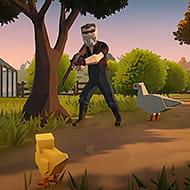
You crouch next to three other cows in the corner of the barnyard, waiting for the meter to move, and your only job is to sound exactly like the ones standing next to you. Moo Who? puts you inside a farm where animal players hide among NPC herds and have to survive by mimicking their assigned species into a live microphone. It sounds simple until the flies start circling and you realize half the herd around you might be hunters in disguise, not the other way around.
| Genre | Multiplayer voice-mimicry party and social stealth |
| Platform | PC |
| Player Count | 2 to 8 players per match |
| Roles | Animal or Hunter |
Recording Your Animal Sound Before You Enter the Farm
Every match starts with a setup step that most first-timers underestimate. You record your own voice making a sound for whichever species you’ve been assigned, whether that’s a cow, a goat, a pig, a chicken, or a duck, and that recording becomes the standard you’ll be judged against for the rest of the round. Players who rush this step end up with a flat, half-committed sound that’s easy for hunters to flag later, because the game keeps holding you to whatever you laid down in those first few seconds.
The better approach, and one you’ll see recommended constantly in community chatter, is to actually commit to the bit during recording rather than treating it as a throwaway formality. A convincing goat bleat or duck quack takes a bit of exaggeration to read as real once it’s coming out of a headset mic in the middle of a chaotic round.
This is also where beginners get tripped up on pacing. You don’t get unlimited time to prepare, so wandering off to explore the map before locking in your sound is a common early mistake that leaves you scrambling once the round actually begins.
Blending Into the NPC Herd Without Overacting
Once you’re dropped into the farm, your task is to physically merge into a cluster of NPC animals matching your species and move like they do. The NPCs graze, shuffle, and idle in loose, repetitive patterns, and hunters have learned to watch for anything that breaks that rhythm. Players who dart between herds or freeze awkwardly in open ground get picked off fast.
Newer players tend to overcorrect by staying completely motionless, which is its own tell, since real NPC animals still shift position occasionally. A duck that never moves for two full minutes reads as suspicious to anyone who’s spent time watching how the actual herd behaves.
Veteran players talk about “reading the herd” before committing to a hiding spot, meaning you watch a cluster for a few seconds to catch its movement pattern before you fold yourself into it. It’s a small habit, but it’s usually the difference between surviving a full round and getting spotted in the opening minute.
What Happens When the Flies Start Circling
Every animal player periodically draws the attention of flies, and this is the moment that defines most rounds of Moo Who?. Once flies appear around you, you have a limited window to make your actual animal sound into the microphone, matching the recording you set at the start, or the flies stay put and start marking your position for anyone nearby.
Failing this check even once in a crowded area is often enough to end your round early, since a visibly fly-covered animal is about as subtle as a flashing sign. The pressure comes from the fact that you can’t predict exactly when a fly check will trigger, so you’re always partly listening for it even while you’re focused on movement.
Some players deliberately position themselves near open space before a check they can feel coming, reasoning that making noise in a crowd draws attention regardless of accuracy. Others stay buried in the herd and accept the risk, betting that a decent sound will pass unnoticed. Neither approach is objectively correct, which is part of what keeps the mechanic interesting round after round.
Reading Hunters and Their Limited Shotgun Shells
Hunters aren’t given unlimited ammunition, and that constraint shapes the entire other side of the match. A hunter who fires at an NPC wastes a shell they can’t get back, so cautious hunters spend long stretches simply observing herds rather than shooting on instinct.
This is where the game’s tension actually lives. A confident hunter who’s tracked your movement pattern will often wait until you break from the group before taking a shot, rather than firing the moment something looks slightly off. If you’ve been sloppy about blending in, you’ll usually feel that pressure building before the shot ever comes.
Landing a hit on a real animal player pushes hunters closer to winning the round, so a single good read from a hunter can swing a match that otherwise looked evenly matched. That asymmetry between unlimited animal disguises and finite hunter ammunition is a big part of what community discussions point to when arguing over whether the role balance favors one side too heavily.
How the Island Map Changes Moo Who?’s Pace
The original farm layout rewards tight, cautious play, with dense herd clusters and short sightlines that make it easier to disappear. The Island map, added in a later update, opens things up considerably, with more scattered terrain and longer sightlines that make pure hiding riskier.
Players who built their habits entirely around the farm map often struggle when they first move to the Island, since the herd-blending strategy that worked in tight corners doesn’t translate cleanly to open ground. Movement discipline matters more here, because there’s simply less cover to lean on.
Hunters, in turn, tend to play more aggressively on the Island, since spotting outliers is easier when herds are spread thin. Rounds here generally run faster and feel less forgiving of mistakes than a farm round does.
Chasing the Farm Legend Achievement in Moo Who?
Farm Legend sits at the top of the achievement list as the one tied to completing every other achievement in Moo Who?, which makes it more of a long-term project than a single-session goal. Getting there means surviving as every species, landing hunter eliminations, and clearing whatever smaller milestones the game tracks along the way.
Community feedback has flagged this particular achievement as inconsistent, with some players reporting it won’t unlock even after every prerequisite is technically complete. That kind of friction shows up in discussion threads fairly often, and it’s a fair example of the rough edges you’ll still find in a game this early in its life.
Chasing it anyway tends to push you toward playing roles and species you’d normally avoid, which isn’t a bad thing for actually learning the game’s full range.
How many players can join a single Moo Who? match?
Matches support between two and eight players split across animal and hunter roles, with the exact split adjusting based on lobby size rather than a fixed ratio.
What happens if you fail to make your animal sound in time?
Flies remain visibly clustered around you, which makes your position noticeably easier for hunters to notice, especially if you’re caught in open ground rather than deep inside a herd.
Can hunters tell the difference between NPC animals and real players just by looking?
Not reliably. Hunters rely on movement patterns, hesitation, and fly checks rather than any visual marker, which is why cautious observation tends to beat impulsive shooting.
Moo Who? works because it turns something as silly as a fake duck quack into a genuine source of tension once a fly check hits at the wrong moment near a hunter with one shell left. Whether you’re grinding toward Farm Legend or just trying to survive a single Island round without breaking herd rhythm, the game keeps asking you to commit fully to a bit that always feels one bad noise away from falling apart.