









Burn With Me
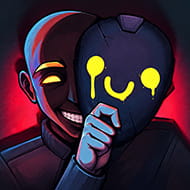

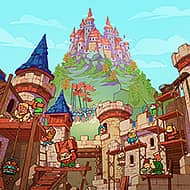
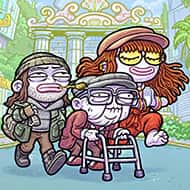

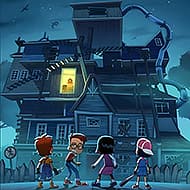
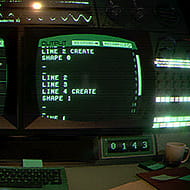
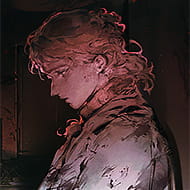

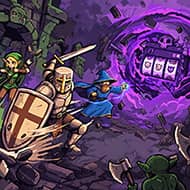

Burn With Me looks like a cozy storybook about talking-animal students and a friendly Teacher, but it plays like a tight scoring puzzle where every card you draw costs you a card. The hand-drawn art and the strangely gentle jazz make the occult rituals feel like a study group, while the board quietly demands exact numbers every round. That gap between warm atmosphere and sharp arithmetic is what players call cozy dread, and it is the reason the game sticks in your head.
| Genre | Narrative roguelike deckbuilder |
| Players | Single-player |
| Structure | Six chapters, each built around a different student |
| Rounds | 12 to 14 per chapter with a checkpoint roughly halfway |
| Board | Five-card pentagram |
| Signature Mechanic | Burning cards to draw new ones |
The Five-Card Pentagram and the Scoring Puzzle in Burn With Me
Every round is played on a pentagram with five slots, and your only goal is to reach a required point total before the round ends. Each card carries its own stats and effects, so placement matters as much as the cards themselves. Some cards care about their neighbors, others change the total directly, and others reach into your hand. That position-based synergy is the part players talk about most, because the same five cards can score very differently depending on the order you lay them down.
At the start of every round the game offers three cards and you keep one, which joins your deck once the round ends. Over a chapter you shape a strategy out of whatever the offers allow.
In the first chapter the cards lean almost entirely on neighbor interactions, so the opening hours teach positioning without overwhelming you. Puzzle fans will enjoy this stretch the most, since a round often feels like a small riddle with one tidy solution that you only spot after moving a card two slots over. The cards are also unusually well drawn, with almost 100 of them carrying alternative secret visuals from invited artists, which gives collectors a reason to look closer.
What Burning a Card Really Costs
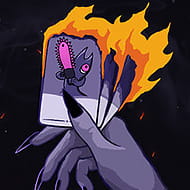
The mechanic that gives the game its name is tied to drawing. To pull a new card you have to burn one you already hold, and that card is gone for good. The draw itself is random, so you are trading a card you chose for a card you did not choose, and every burn is a small bet on your own deck. Some cards gain extra effects when they burn, which turns destruction into a plan rather than a loss.
This is where the deck-burner label earns its place. Burn too much and you run out of material, burn too little and you stall without options, and the right balance changes from chapter to chapter.
- Chapter one builds around cards that react to their neighbors
- Chapter two introduces cards that steal stats and cancel the effects of other cards
- Chapter three makes burning a full strategy, with a phoenix that returns the next round with more power after it burns
By the time the phoenix appears in chapter three, burning stops being a cost and becomes a resource, which is a clever echo of a story about trading something precious for a wish. Roguelike veterans tend to enjoy that turn most, because it rewards planning two rounds ahead instead of just reacting to the current hand.
Six Chapters, Six Students and One Passionate Teacher
The story follows occult university students who learn forbidden rites from the Teacher, an anthropomorphic professor with a habit of oversharing. Each chapter belongs to a different student and builds toward the ritual that drives the whole game: summoning a Personal Demon that grants a wish. The catch, repeated in every chapter, is that the wish rarely arrives the way the summoner pictured it.
Alan opens the story. He carries a demonic arm and wants his normal body back, and he turns out to be a natural-born occultist who masters the rituals with ease. His wish is granted, yet if you catch him from the right angle for a split second, the illusion slips. It is the kind of detail that delivers the comforting strangeness the whole story is aiming for.
Each chapter’s gameplay is shaped by that student’s deepest fears and obsessions, so the rules shift as the story does. A full run on normal difficulty takes a couple of hours, which makes the story easy to finish in one or two evenings. Story readers get the most out of this structure, since the narrative scenes are voiced and the card puzzles act as the ritual itself rather than a break from the plot.
Sanity, the Glass Heart and Where Burn With Me Pushes Back
Bad rounds are softened by the sanity system, a glass heart in the bottom-right corner of the screen. For every three points you score above the required total, you earn one sanity point, so an 18 against a requirement of 15 fills one point. You can bank up to ten, and a fully charged heart can add up to ten points to a round when you desperately need them. Spending that reserve at the right moment is one of the quieter skills in the game.
Presentation does a lot of the heavy lifting. The animated hand that reacts to almost every action was filmed from a real hand and stylized to match the drawings, and clicking it reveals a few extra animations. Story scenes are voiced and jazz plays between them, though the music works better as pleasant background than as something that stays with you afterward.
On normal difficulty the game is forgiving enough that a few mistakes still clear the requirement, but on high difficulty the randomness stacks from three sources at once: the three cards offered after each round, your starting hand, and the random card you are forced to burn when drawing. Each chapter runs 12 to 14 rounds with a checkpoint roughly halfway, and losing sends you back to it, so a streak of bad luck late in a chapter can cost a lot of time. This is the part that divides opinion, since some players love the pressure and others feel the outcome slipping out of their hands.
Questions About Burning, Chapters and Length
- How long is Burn With Me? A full run through all six chapters on normal difficulty takes about a couple of hours, with each chapter lasting 12 to 14 rounds. Replaying a single chapter on high difficulty can take roughly as long again, because the halfway checkpoint sends you back mid-chapter when a run goes wrong.
- What happens when you burn a card? The card is gone and you draw a random replacement, so burning is both a cost and a gamble. Some cards gain extra effects when burned, and in chapter three the phoenix returns the next round with more power, which turns a burn into an investment.
- Is high difficulty fair? Normal difficulty forgives a few mistakes, but high difficulty raises the required score while the offered cards, your starting hand and the forced burn all stay random. Banked sanity from the glass heart can rescue an unlucky round, though it cannot fully cancel a run of bad draws.
Burn With Me is ultimately a small, strange ritual about what you are willing to throw into the fire: the cards you burn to draw, the sanity you bank in the glass heart, and the wish each student asks their Personal Demon to grant. Whether it is Alan’s slipping illusion or the phoenix coming back stronger that stays with you, every sacrifice feels like part of the story rather than just a number on the pentagram.