





















Combolands




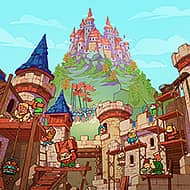






You drop a Trading Post on an empty tile, and before the placement animation even finishes, two icons flare up next to a Shrine three spaces away. That’s the first ten seconds of Combolands, and it doesn’t really let up. What starts as a quiet little town-building sketch turns into a chain reaction of triggers almost immediately, and the run you’re playing right now already looks nothing like the one you’ll start after this.
| Genre | Roguelike Citybuilder / Deckbuilder Hybrid |
| Session Length | Around 30 minutes per run |
| Guild Pool | 7 guilds, 2 chosen per run (21 combinations) |
| Buildings | 120+ |
| Passive Items | 100+ Heirlooms |
| Progression | 10 ranks, including Baron |
Two Guilds, One Chain Reaction
The core loop in Combolands sounds simple on paper: pick two guilds, place buildings on a procedurally generated island, and watch for synergies. In practice, the game is really about reading which combinations trigger which cascades before you commit tile space to them. A Trading Post next to a Shrine might do almost nothing, while the same Trading Post next to a Reliquary can set off a chain that ripples across half your hamlet.
Beginners tend to place buildings the way they would in a straight citybuilder — filling gaps, optimizing for pure output. That’s the wrong instinct here. The game rewards clustering buildings that share a trigger condition, even if it means leaving obvious open space unused early on. Players in the community call this “stacking the combo,” and it’s the single biggest jump in efficiency once it clicks.
There’s also a timing element that’s easy to miss on a first run. Some structures only fire their bonus once per in-game cycle, so dropping three of the same building next to each other isn’t automatically better than spacing one Trading Post against three different partners.
Blueprints, Vaults, and What Beginners Get Wrong in Combolands
- Treating Blueprints as disposable instead of stacking matching types together
- Ignoring the Vault until population growth stalls out
- Skipping the second guild’s identity entirely and building only around the first
- Chasing every Heirloom offered instead of ones that match the current combo
Blueprints stack when they share a building type, which isn’t obvious the first time you see one appear in the offer pool. A lot of new players discard duplicates thinking they’re redundant, when in fact stacking them is one of the more reliable ways to snowball a run past the midpoint. The Vault works similarly — it’s easy to overlook in the opening minutes because its payoff is slow, but by the time your hamlet has grown past its first few blocks, a Vault sitting idle is a wasted tile.
Completionist-minded players tend to grab every Heirloom the game offers, which sounds efficient but often dilutes a run that was otherwise leaning hard into one guild identity. Meanwhile, players who enjoy min-maxing a single build will skip flashy Heirlooms entirely if they don’t feed the existing chain, which is closer to how the game is actually meant to be read.
Climbing Toward Baron Without Losing the Chain
Combolands gates its difficulty through ranks rather than a single escalating timer, and population targets climb noticeably the further you go. By the time a run reaches Baron rank, the game expects a city that’s still generating combo triggers efficiently, not just one that’s technically large. This is where a lot of runs quietly fall apart — a player builds outward for size instead of density, and the population curve simply outpaces the income.
Early in the game, almost any reasonable guild pairing can carry a run to the first few ranks. Once you’re several ranks in, though, the map starts punishing loose, unfocused placement, and that’s usually the point where a first-time player restarts to try a tighter build instead of pushing forward with a weak one.
City councillors add a second layer on top of guild choice, and recruiting the right one for a given combo can smooth out a rank that would otherwise stall a run completely. Strategy-focused players tend to treat councillor choice as seriously as the initial guild pick, while more casual players often grab whichever one is offered first — which works fine for the earlier ranks but starts to matter a lot more later.
The Part Players Actually Argue About
Not everything about Combolands lands cleanly with its audience. The procedural map generation means some runs simply hand you a better starting layout than others, and there’s genuine debate in the community about how much of a strong run comes down to smart play versus a friendly island seed. It’s not a dealbreaker for most players, but it’s a fair criticism, and one the developers have acknowledged is worth tuning further.
That honesty is part of why the game has built the following it has. When a run does come together — when a Shrine, a stacked Blueprint line, and a well-timed Vault all fire in the same turn — the “number-go-up” moment the community keeps referencing is real, and it’s the reason so many players queue up “just one more run” long after they meant to stop.
What is the fastest way to unlock new guilds in Combolands?
New guilds unlock through normal play rather than a separate meta-currency grind, so simply finishing runs and climbing ranks is the intended path. Players report that guilds tend to unlock at a steady pace across the first several sessions rather than all at once.
How many guild combinations does Combolands actually have?
With 7 guilds and 2 picked per run, there are 21 possible starting combinations, and each pairing changes which buildings and Heirlooms show up most often in the offer pool.
Is Combolands hard to learn for someone new to deckbuilders?
The core rules are light enough to grasp in a single run, but reading combo chains well enough to reach the higher ranks, like Baron, takes several attempts. Most of the difficulty comes from spatial planning rather than complicated systems.
Combolands keeps its promise of a short, sharp run better than most games in the genre attempt to, and the fact that a single misplaced Reliquary can unravel an otherwise strong hamlet is exactly why players keep coming back to try a cleaner combination. Once the chain-reading instinct sets in, thirty minutes with Combolands rarely feels like enough.