














Everything is Crab








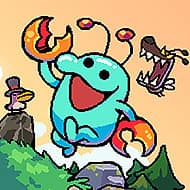
You start a run as something barely resembling an animal — a smear of legs and a single defining trait — and twelve minutes later you’re a fur-covered, wing-flapping, pincer-wielding creature that shouldn’t exist in any real ecosystem. That’s the loop in Everything is Crab, and it never really stops surprising you, even after your fortieth attempt to avoid the inevitable.
| Genre | Action, Roguelite, Simulation, Strategy |
| Perspective | 2D, top-down |
| Players | Single-player |
| Core Loop | Evolve, survive biome hazards, avoid full carcinisation |
The Premise Behind Everything is Crab
The joke baked into the title is also the mechanical spine of the game: biologists have long noted that a huge number of unrelated crustacean lineages have independently evolved into something crab-shaped, a real phenomenon called carcinisation. Everything is Crab takes that idea and turns it into a survival countdown. Left unchecked, your creature drifts toward crab traits whether you want them or not, and the entire point of a run is choosing whether to lean into that drift or fight it with a completely different build.
This isn’t a game about following a fixed path from small animal to big animal. Every run hands you a starting Genetic — one of several base characters — and from there the 125-plus evolutions on offer let you build something that might end up looking like a flying otter with a stinger tail, or it might actually end up a crab, because sometimes the crab build is just the strongest option on the table.
What keeps pulling players back in is that no single strategy dominates. Some runs reward a ferocious predator build that out-aggros everything on the map; others reward a nimble nomad who never gets caught outdoors when a storm rolls in. Both are valid ways to beat the game’s escalating pressure.
Reading the Living Ecosystem
Everything is Crab places you inside four distinct biomes, each with its own climate events, points of interest, and resident wildlife going through their own evolutionary stages independently of you. A blizzard that rolls in unannounced can wreck a run if you’re caught without cold-weather traits, and the day-night cycle changes which creatures are actively hunting versus resting.
Early in the game, most players die to something dumb — wandering into a predator two evolution stages ahead of them, or trying to fight when fleeing was the correct call. By the time you reach the later biomes, the ecosystem stops feeling like scenery and starts feeling like a second opponent with its own agenda, which is exactly the shift the design is going for.
- Predators and prey evolve on their own timers, independent of your choices
- Weather events like blizzards punish builds with no insulation
- Points of interest offer scavenging opportunities but often attract competition
Evolutions, Specialisations, and Getting Darwin’d
The evolution menu is where Everything is Crab earns its replayability. Legs, claws, wings, fur, tails, tentacles — the combinations stack in ways that are often visually ridiculous and mechanically sound at the same time. Community shorthand for a bad run ending is getting “Darwin’d,” and it happens constantly, usually because a player grabbed synergistic offense evolutions while ignoring the mobility or defense they needed to survive the biome they were actually in.
One evolution players talk about constantly is Moulting, an escape tool that briefly changes your creature’s state — useful, but recent balance notes fixed an exploit where using it mid-blizzard could launch you across the map in the wind’s direction, which tells you how deep the interactions between mechanics can get.
Beginners consistently overvalue raw damage evolutions and undervalue traits that help with detection and escape. Survival in this game is rarely about winning a fight; it’s about avoiding fights you can’t win in the first place, which is a mindset shift that takes a few runs to click.
Bosses, Genetics, and the Meta-Progression Layer
Beyond a single run, Everything is Crab layers in a meta-progression system that includes unlockable Genetics — alternate starting characters — a difficulty system for players who want the game to actively fight back harder, and Challenge Scenarios that isolate specific survival problems. One of the recurring bosses, Clawdia, has become something of a community fixture, referenced constantly in patch notes and player discussion alike.
The Codex tracks everything you’ve discovered, which matters more than it sounds like it should, since a huge part of the appeal is slowly filling in the picture of what’s actually possible to evolve into. Reaching Endless mode — unlocked by proving yourself in standard runs — strips away the timer entirely and turns the whole thing into a pure survival test against an ecosystem that keeps escalating without end.
What Players Debate About Everything is Crab
Not every reaction is uncomplicated praise. Some players find the early hours a little directionless before the evolution options start clicking into a coherent build, and the difficulty curve between early biomes and later ones can feel like a sharp jump rather than a gradual slope. It’s a fair criticism, and one the developers have addressed somewhat with ongoing balance passes and new evolutions added post-launch.
Still, the core hook holds up.
What does carcinisation mean in Everything is Crab?
It’s the game’s central joke and mechanic rolled into one: your creature naturally drifts toward crab-like traits over time, referencing the real biological phenomenon where many unrelated species converge on a crab body plan, and avoiding or embracing that drift shapes your entire build.
How many evolutions are in Everything is Crab?
There are more than 125 evolutions and specialisations available, covering offense, mobility, defense, and utility traits that combine differently depending on which starting Genetic you picked.
What happens when you get Darwin’d in Everything is Crab?
Getting Darwin’d is community slang for a run-ending death, usually caused by an unbalanced build that ignored survival traits in favor of aggression, and it’s treated as a badge of honor as much as a failure state.
Everything is Crab rewards the kind of player who’s willing to lose a dozen runs figuring out why Clawdia keeps wrecking their build before it finally clicks. The game never punishes experimentation harshly enough to make you stop trying weird combinations, and that’s precisely why so many players describe losing entire evenings to just one more attempt.