



















Innards
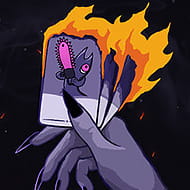


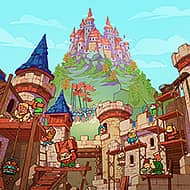




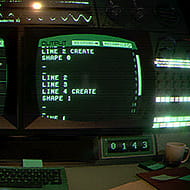


You’re dropped into a world that used to be the internet, except the internet died decades ago and something kept living inside its rotting infrastructure. That’s the starting situation in Innards, an action-adventure built entirely around hyperbolic geometry — a non-Euclidean space where hallways curve in ways your instincts weren’t built to predict, and where distance itself stops behaving the way it does everywhere else you’ve ever played a game.
| Genre | Action / Adventure |
| Setting | Hyperbolic non-Euclidean space |
| Playable Character | Dex |
| Core Focus | Herding enemies, navigating curved space, destroying rafflesias |
Dex and the Ruins of the Withinternets
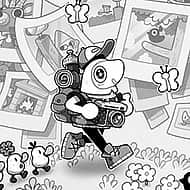
You play as Dex, a low-level functionary for a crime syndicate operating inside the Withinternets — the decomposed remains of a long-abandoned digital network that never fully died, just kept mutating. Dex isn’t a hero by any stretch; the framing text describes him as a “no-muscle for hire” who’d rather do the bare minimum than actually earn his keep, which sets a distinctly grimy, unglamorous tone compared to most hyperbolic or non-Euclidean games that tend to lean mystical instead.
What’s left of the old network has decomposed into something biological rather than mechanical — rotting viscera reshaped by selection pressure into strange, self-assembling machines. The game leans hard into this body-horror-meets-digital-decay aesthetic, and it’s one of the more distinctive tonal choices separating Innards from typical curved-space experiments that stay purely abstract.
Community discussion around Dex tends to focus less on his backstory and more on how unglamorous his motivations are — he’s not saving anyone, he’s just trying to get through another job, and that flatness is part of the game’s dry, deadpan sense of humor.
Junkbags and the Radiculating Networks They Inhabit
The creatures populating this world are called Junkbags — self-assembling digital natives that vary wildly in form, size, and ambition. Some are barely functional, others are sharp enough to run their own small operations within Junkbag society, which the game describes as forming radiculating, root-like networks that carry passengers, capital, and violence along the twisting geometry of the setting.
Beginners consistently underestimate how much health early Junkbags have. First encounters tend to feel like a slog until you realize the game isn’t built around raw damage output so much as herding — using terrain, positioning, and the curved geometry itself to funnel groups of Junkbags into situations you control rather than trading hits directly.
Once you get a feel for herding, the loop opens up considerably. Advanced players talk about using the hyperbolic terrain itself as a weapon, looping enemies through folded space to group them up before committing to an attack, since chasing individual Junkbags one at a time across curved ground wastes far more time than it should.
Rafflesias and the Shape of Progress
Scattered across the Withinternets are structures called rafflesias, and destroying them functions as the game’s primary marker of progress. Every approach to a rafflesia plays out like its own small dungeon crawl, since the hyperbolic layout means the most direct-looking path is rarely the fastest one — a detail players frequently bring up when discussing how disorienting the world can feel even after dozens of hours.
Combat against tougher Junkbag clusters near a rafflesia site tends to reward patience over aggression. Players who rush in expecting a straightforward brawl often find themselves boxed into a fold of space they didn’t notice was there, which is exactly the kind of moment the developer has described wanting the world to produce on purpose.
Once you clear enough rafflesias, the shape of the surrounding Withinternets itself starts to feel more navigable — not because the geometry changes, but because your read on hyperbolic space genuinely improves the longer you spend in it.
Navigating a World That Refuses to Behave
The single most divisive aspect of Innards, by the game’s own design, is disorientation. Distances that look short can take far longer to cross than expected, and paths that appear to loop back on themselves sometimes don’t. Some players find this the entire appeal — a genuinely alien sense of space no traditional 3D game can replicate. Others bounce off it within the first hour, unable to build reliable spatial intuition.
- Terrain in hyperbolic space can technically hold more “room” than it visually appears to from a distance
- Enemy herding works best when you use curved corridors to your advantage rather than fighting on flat, open ground
- A known bug causes a black screen with certain gamepad setups — disconnecting and reconnecting controllers resolves it
The custom engine built specifically to render this kind of space is part of why the game feels like nothing else on the platform; more conventional engines simply weren’t designed to handle geometry that behaves this way.
Innards isn’t trying to be comfortable, and that’s precisely the point — a hyperbolic world populated by Junkbags, anchored by a deeply unheroic protagonist in Dex, and structured around the slow satisfaction of learning to read a space that was never meant to make intuitive sense. Whether you’re herding enemies toward a rafflesia or just trying to figure out which direction is actually forward, the game asks you to unlearn everything flat geometry taught you first.