


















Keep It Up!










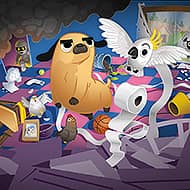
You jump toward the ceiling, slap the balloon upward, and a teammate barrels into you at exactly the wrong moment. The balloon wobbles, drifts toward the floor, and the whole room holds its breath for half a second. That scramble is what Keep It Up! is built around, a co-op slapstick physics game where the only rule is that the balloon must never touch the ground.
| Genre | Co-op slapstick physics |
| Platform | Windows PC |
| Players | Single-player or up to four test subjects |
| Perspective | First-person |
| Goal | Keep the balloon off the floor in every room |
Slaps, Jumps, and Collisions in Keep It Up!
The core loop is almost insultingly simple. You and up to three other Facility test subjects share a room with one balloon, and you keep it airborne by slapping it, jumping into it, or colliding with it. Because the physics are loose and silly, every touch sends the balloon somewhere slightly different, and two players going for the same hit often ruin it for both. Calling out who takes the next touch is the unofficial skill that separates smooth rooms from total chaos.
Slapping your teammates is also on the table.
Beginners tend to chase the balloon all at once, which clumps everyone together and leaves nobody ready when it bounces away. A better habit is to let one player stay close to the balloon while the others spread out to cover the edges of the room. Players who love party games will adapt quickly because the game rewards loud communication, and solo players are not locked out, since single-player is supported too.
Balloons as Lives: How Drops Add Up
Each drop costs you one balloon, and when the last balloon is gone the whole team is out. That shared pool turns every mistake into a group problem, because nobody falls alone. A drop in an early room stings less than a drop in a later one, since the later rooms are designed to make recovery harder.
The smart way to think about the balloon count is as team money. Spend it on experiments in easy rooms, hoard it before a room you have already failed, and never gamble a balloon just to save a few seconds.
Honesty is worth adding here. Shared punishment divides players, because some love the tension of a team-wide wipe while others find it frustrating when one teammate’s mistake ends a long run, especially with strangers. Coordinated groups will enjoy it most, and anyone playing with random teammates should expect a few angry moments.
Rooms Built to Break Your Rhythm
The store description promises that each room is a new test and each test is harder than the last. Once the layouts turn unhinged, the comfortable rhythm you built in early rooms stops working, and you have to relearn how the balloon moves around each obstacle. These are the hazards players talk about most:
- Fans: they add forces you have to plan around, so a slap that worked before may send the balloon the wrong way.
- Spikes: they mark the zones where the balloon, and you, should not end up.
- Tight corridors: they squeeze everyone together and make clean hits much harder to land.
- Unhinged layouts: rooms that mix several obstacles at once and demand fast improvisation.
Players who enjoy optimizing routes will love replaying a room to find the cleanest line through it. Anyone who prefers laughing at the disaster will find the same rooms just as entertaining, because failure in this game is rarely quiet.
Customizing Your Dumm-E and Taking the Blame
You play as a Dumm-E, and cosmetics unlock through gameplay instead of a shop. Hair styles, eye shapes, eyebrows, mouths, and outfits all become available as you progress, so the character you wear after several rooms looks different from the one you started with. Completionists will treat the cosmetic list as a second goal on top of surviving the Facility.
Your whole team sees your character, which is where the social side gets sharp. When the balloon hits the floor, everyone knows exactly which Dumm-E to blame.
That visibility makes customization more than decoration. A ridiculous outfit becomes a badge of shame or pride depending on how the last room went, and groups quickly start inventing nicknames for whoever keeps dropping the balloon.
Questions Players Ask About Keep It Up!
- How many players can join Keep It Up!? Up to four can play at once, meaning you plus up to three other Facility test subjects. In-game chat is included, which helps a lot when you need to call out who is taking the next slap.
- Can you play Keep It Up! solo? Yes, single-player is listed among the supported modes. Rooms with fans, spikes, and tight corridors are clearly designed around teamwork, so a solo run means covering the whole room yourself and protecting every balloon carefully.
- What happens when the balloon drops in Keep It Up!? Each drop costs you one balloon, and new rooms bring new hazards that make drops more likely. If you run out, the last balloon takes everybody with it and the run ends in a game over.
Keep It Up! works because it turns a simple rule into a loud, shared problem. Slap well, keep the balloon moving, protect your count of balloons through every Facility room, and remember that your Dumm-E will wear the blame if it falls.