
















RippleLoop









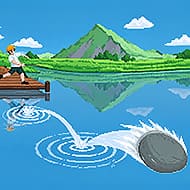
You launch a stone across the water in RippleLoop, watch it bounce, and before the last ring of water settles you are already planning the next throw. Launch, skip, upgrade, go further: that four-beat loop is the whole pitch, and it holds together because every throw ends with a reason to make another one. The game keeps its scope small on purpose, so it is easy to understand in a minute and surprisingly hard to put down once the distances start climbing.
| Genre | Incremental, casual |
| Mode | Single-player |
| Art style | Pixel graphics, minimalist and cozy |
| Core loop | Launch, skip, upgrade, go further |
| Pace | Relaxed, short bursts of play |
What a Single Throw Teaches You in RippleLoop
The core mechanic fits in one sentence: throw a stone and chain as many skips as you can before it sinks. Distance is the measure of every run, and everything else in the game exists to stretch it. Early in the game the throws are short and plain, which is the right moment to learn how the stone behaves on the water, because the bounces are the clearest feedback you get. Watching where a skip chain starts to lose energy teaches you more than any tooltip could.
Beginners usually treat the first handful of throws as warm-ups and sprint to the upgrade list. That is understandable, but it skips the part the game is built around, the rhythm of the skip chain. Players who watch each bounce before buying anything tend to understand why a given upgrade matters instead of just trusting the price tag.
One detail incremental veterans recognize at once is the pause after a throw. The stone sinks, the number settles, and your eyes go straight to the upgrade panel without being asked to. That reflex, the classic number go up pull, is what turns a one-minute idea into a long session.
Short throws are not failures here. They are the cost of entry.
Upgrades, Powers and the Pull of Another Throw
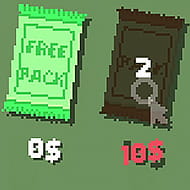
Upgrades are the steady part of progress. Each one lets the stone travel a little further, and the loop rewards patience because small gains stack across every future throw. The sensible habit is to read the upgrade list like a ladder rather than a menu you empty in one sitting, buying whatever changes your next throw before chasing anything flashy.
Powers are the exciting part. They arrive as you advance, and the game talks about unleashing them at full strength, which is where the loop stops being a pure number climb and starts feeling like a toy you can play with. Once a new power unlocks, how well you time it against the bounce is where skill is most likely to matter.
Distance is the one number that never lies. It tells you whether your last purchase changed anything, and it is the fastest way to spot an upgrade that looked good in the list but did little on the water. Check it after every purchase and you will waste far less of what your throws earn.
The Calm World Around the Water
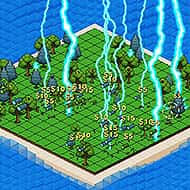
The art is pixel-based and deliberately gentle, with a minimalist, colorful look that stays out of the way of the throw. The game describes itself as a calm world you discover as you advance, which means that going farther is also how you see more of the water and the land around it. That quiet sense of exploration is why players tag it as cozy and relaxing even though every throw is an action.
Because a throw is quick, a bad one tends to cost seconds rather than progress, so experimenting never feels punished. You can try an odd upgrade order, watch the skip chain collapse early, and be back at the water almost immediately. Players who like to keep a low-stakes game open between heavier sessions will appreciate how little the loop demands of them.
Sailing and physics tags show up beside the cozy ones, and they fit a game built around momentum and water. Those tags point at a loop that is about how the stone moves across the surface, not about beating anything.
Who RippleLoop Suits and Where It Might Bounce Off
Players often ask whether RippleLoop is an idle game or one you actually have to play. The answer sits in between: it carries both idler and action tags, because you throw the stone yourself while progression grows the way an incremental does. It is hands-on in short bursts, not something you leave running while you walk away.
Players coming from idle clickers will recognize the shape of the loop right away, and they are the audience most likely to enjoy watching distances climb. Players who want a story, enemies or branching builds will probably bounce off, because the loop is deliberately narrow. How deep the later upgrades and powers run is a question players are still working out, and that open question is the honest trade-off of any small incremental.
Patience matters more than reflexes here. A long skip chain feels earned precisely because the early ones are modest, so treat the first few throws as groundwork rather than a verdict on the whole loop.
RippleLoop is at its best when you stop counting and start watching a single stone cross the water, then spend what that throw earned and send it out again. The upgrades make each skip chain a little longer, the powers give the loop a moment of release, and the calm world keeps rewarding the extra distance. If a quiet incremental about one stone and one stretch of water sounds right, that is exactly the pace it asks for.