
















Sir, We Have an Orc Problem







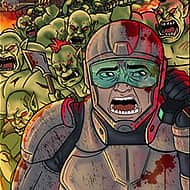
You watch the tree line ripple as the first wave crests the hill, and by the time you’ve counted past a hundred Orcs pouring down the slope, you already know your two starting Gunners won’t hold this choke point alone. That’s the opening minute of Sir, We Have an Orc Problem in a nutshell: a calm setup phase followed by a flood you’re never quite ready for the first time you see it.
| Genre | Incremental tower defense |
| Platform | Windows, SteamOS |
| Stages | 24 at launch |
| Core Loop | Place turrets, survive orc waves, spend earned resources on permanent upgrades between runs |
Choke Points and Turret Placement in Sir, We Have an Orc Problem
The pathing works like a crowd, not a queue. Orcs flow around walls and corners the way water finds the lowest gap, which means a wall placed a few tiles wrong doesn’t just fail to help — it actively funnels enemies somewhere you didn’t plan for. Most veteran players build their opening layout around one or two real choke points rather than spreading turrets thin across the whole map, because a Gunner covering an open field does far less work than the same Gunner locked onto a narrow gap between two walls.
Flamethrowers reward this kind of layout more than almost anything else in the roster. Put one at the front of a choke and it turns a packed lane of Orcs into a burning bottleneck, buying time for slower, harder-hitting turrets behind it to finish the job.
New players often build wide before they build deep, unlocking three or four different turret types in the first few runs instead of committing resources to upgrading one properly. Early economy upgrades matter more than turret variety at this stage.
What New Players Get Wrong Early in Sir, We Have an Orc Problem
The single most common mistake is treating every failed run as wasted time. Resources carry over whether you win or lose, so a battle that ends badly still funds the next attempt. Players coming from stricter tower defense games tend to reload or restart the moment things look grim, when the better habit is to let the wave finish, bank whatever resources dropped, and adjust the layout on the next attempt.
The second mistake is ignoring economy upgrades in favor of raw damage. A slightly stronger Cannon feels satisfying immediately, but a cheaper upgrade to resource generation compounds across every future run.
Completionist players in particular tend to over-invest early, trying to max every branch of the upgrade tree before touching the harder stages. It’s usually faster to push forward with an incomplete tree and backfill upgrades once resource income is higher.
Silver Orcs and the Economy Layer
Silver Orcs show up once the matching economy upgrade is purchased, and they behave less like a combat threat and more like a walking bonus. They don’t require a separate route or a dedicated kill zone — treating them as an income event rather than a new mechanic to plan around is the right mental model. Kill them with whatever’s already covering that lane and move on.
This is a small design touch, but it’s one of those things you only really notice once you’ve played a dozen or more runs and started paying attention to where your resource curve spikes mid-battle.
Reading Level 6.2 Without Panicking
Level 6.2 is where a lot of players hit their first real wall. The middle of the fight looks the busiest — screen full of orcs, turrets firing constantly — but the actual danger tends to arrive at the very end, when a small leftover group has already slipped past the main damage line while attention was on the crowded center. Treating the last acceleration as the real test, rather than the visually chaotic midpoint, changes how you build for this stage.
Players discussing this level in the community consistently bring up the same lesson: don’t overcommit turret slots to the middle stretch, and keep at least one flexible unit that can clean up stragglers near the exit.
By the time you reach Level 6.2, you should already have a Tesla Coil or Laser unlocked. Neither is mandatory, but both make the late cleanup dramatically less stressful.
Tesla Coils, Lasers, and When Splash Damage Wins
Tesla Coils hit in a radius and chain between nearby targets, which makes them a natural pick for maps where orcs bunch up rather than filing through a single narrow gap. Lasers do the opposite job well: they punch through a straight line, which matters most on stages with a long wall segment that needs consistent penetration rather than area coverage.
Mortars round out the splash-damage side of the tree. They’re slow to fire but forgiving of imperfect placement, which makes them a reasonable fallback while you’re still learning a new map’s pathing.
- Flamethrower — best at chokes, weak against spread-out lanes
- Tesla Coil — strong against clustered Orcs, chains between targets
- Laser — best for long, straight walls needing penetration
- Mortar — forgiving splash damage, slower fire rate
Farming Runs Instead of Chasing a Flawless Clear
A lot of the discussion around Sir, We Have an Orc Problem in player communities centers on farming: deliberately replaying an easier stage to build up resources rather than pushing forward into a stage you’re not ready for. It’s not the flashiest strategy, but it’s consistently the one experienced players recommend to anyone stuck on a specific level.
This is also where the game’s shorter campaign becomes a real talking point. Reception has been largely positive, but a recurring criticism is that the current map and turret roster feels thin once you’ve farmed your way through the upgrade tree — a fair complaint, and one the difficulty curve doesn’t fully hide.
How do Silver Orcs work in Sir, We Have an Orc Problem?
Silver Orcs appear once the related economy upgrade is unlocked and function as a bonus income source rather than a distinct threat. They don’t need their own tower layout — any turret already covering that lane will handle them while contributing extra resources to your run.
What turret should I unlock first?
Most guides recommend a Gunner or Flamethrower at your main choke point before branching into Cannons or Mortars. Early economy upgrades typically matter more than a second turret type.
Is the game worth playing if the campaign is short?
If you enjoy incremental upgrade loops and don’t mind a compact 24-stage campaign, yes — the physics-driven crowd chaos and turret variety hold up well even on repeat farm runs, though players wanting a longer campaign or more maps will likely want to wait for future updates.
Sir, We Have an Orc Problem earns its keep in short, tense bursts rather than long sessions, and that’s exactly the point — you’re never more than a wave or two from either a clean clear or a scramble to save your last choke point before the orcs reach the wall.