




















Teach My Little Sister How To Drive




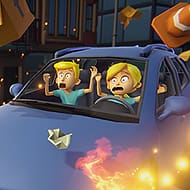
You buckle into the passenger seat with nothing but your voice and a checklist you’ll forget the second the engine turns over, and you watch your sister’s knuckles go pale on the wheel before the car has even cleared the driveway. Teach My Little Sister How To Drive puts you there for the whole ride, and for once you can’t grab the wheel yourself when things go sideways.
| Genre | Simulation, Casual |
| Perspective | Passenger seat, voice-based instruction |
| Course Types | Four escalating lesson categories |
| Goal | Get her through every lesson without a crash |
Voice Commands That Actually Work in Teach My Little Sister How To Drive
The core loop sounds simple until you’re mid-lesson and realizing that timing matters more than volume. You can’t steer, brake, or accelerate yourself, so every correction has to land as a spoken cue before the mistake actually happens, not after. Say “brake” a half-second late on a tight turn and she’s already overcorrecting into the curb, which teaches you fast that this game rewards anticipation over reaction.
Early lessons are forgiving about phrasing, but once road driving opens up, vague instructions start costing you. “Slow down” works fine in a parking lot; on an actual street with other cars, you need to be specific about when and how much.
Players who’ve spent time with the demo describe settling into a rhythm where you’re narrating almost constantly, calling out hazards a beat before she reaches them rather than waiting for her to react first.
Reading Your Sister Before She Overcorrects
Her nerves are as much a system as the driving physics. She flinches at sudden inputs, hesitates at intersections, and if you snap at her too many times in a row, she gets sulky and starts talking back instead of listening, which makes the next mistake more likely rather than less. That feedback loop is the actual difficulty curve — it’s not that the roads get harder in a vacuum, it’s that a rattled driver handles the same road worse.
This is where the passenger-seat framing does real work. You’re not just issuing commands into a void; you’re managing a person’s confidence in real time, and a harsh tone at the wrong moment can undo three clean maneuvers in a row.
Calmer players tend to do better here than shouters, which feels intentional given how much of the marketing leans on the comedy of things going wrong when you lose your patience.
S-Curves, Parking, and the Moments Panic Sets In
The four course types escalate in a fairly obvious order — simple S-curves first, then parking, then full road driving, then emergency scenarios layered on top of whichever base course you’re running. S-curves teach the fundamentals of early and late braking cues, and if you can’t get those clean, parking becomes miserable because it demands the same precision at much lower speed with much less margin for error.
Parking sections are where a lot of players report their first real frustration, since the tolerance for drift is tighter than the S-curve lessons prepare you for.
Road driving introduces other traffic, which changes your job from pure technique coaching to constant hazard-calling, and that shift is where the game stops feeling like a tutorial and starts feeling like an actual test of nerve.
Handling the Emergency Events Without Losing Your Cool
Emergency events are dropped into any of the other course types without warning, and they’re built around the idea that panic is contagious between the two of you. A sudden obstacle or a car cutting in forces you to bark a fast, clear instruction, and how you deliver it feeds directly back into her nerve system described above.
Veterans of the demo talk about developing a specific low, flat tone reserved only for emergencies, so that when it shows up, she recognizes it as different from normal coaching chatter and reacts faster.
It’s a small trick, but it’s the kind of thing that separates players who treat this as a comedy game from players actually trying to survive lessons cleanly.
Why Teach My Little Sister How To Drive Feels Different From Ordinary Driving Sims
Most driving games measure you against the car. This one measures you against a relationship, and that reframing is what makes the voice-only restriction interesting instead of gimmicky.
The tradeoff is real, though — voice-based control can feel finicky when you need to fire off a correction in under a second, and players who prefer precise manual input may find the whole premise more stressful than fun rather than charmingly tense.
Whether that friction reads as the point or as a flaw probably depends on how much patience you have for being backseat-driven right back at.
What happens if you give your sister the wrong instruction?
Wrong or mistimed instructions in Teach My Little Sister How To Drive tend to compound rather than cause instant failure — she’ll overcorrect, drift, or hesitate, and if you follow up with another late cue, the mistake snowballs into a harder recovery than if you’d said nothing at all.
How many lesson courses are there in Teach My Little Sister How To Drive?
There are four core course types — S-curves, parking, road driving, and emergency scenarios — with emergency events able to layer on top of any of the other three rather than existing as a separate standalone mode.
Does yelling at your sister make things worse in Teach My Little Sister How To Drive?
Yes — repeated harsh instructions push her into a sulky, talk-back state where she’s less responsive to subsequent commands, which is the game’s way of punishing tone rather than just punishing bad calls.
By the time you’ve white-knuckled through a full emergency-laden road driving lesson, Teach My Little Sister How To Drive has quietly taught you that the sulking and the overcorrections were never separate problems from the driving itself — they were the actual test the whole time.