





















A Game About Chopping Trees











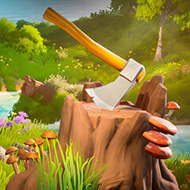
Most browser survival titles open with a cutscene, a narrator, or at least a tutorial pop-up. A Game About Chopping Trees opens with a tree, an axe swing animation, and nothing else. There is no story beat to skip and no menu screen explaining the stakes, just a patch of forest and the assumption that you already know what chopping wood is for.
That bluntness is either the game's biggest strength or its biggest weakness depending on who you ask. Genre veterans appreciate being dropped straight into the loop without hand-holding, while newer players sometimes bounce off the lack of onboarding entirely. Both reactions show up regularly wherever this style of small survival build gets discussed.
The First Swing in A Game About Chopping Trees
The opening minute is entirely about one action: walking up to a tree and swinging an axe at it until it falls. There's no elaborate mini-game layered on top, just repeated hits until the trunk gives way and drops logs onto the ground nearby.
What trips up beginners immediately is assuming one tree is enough to get started. A single trunk rarely produces enough wood to do anything meaningful with, so the real first task is chopping several trees back to back before the resource counter says anything useful is possible.
The other early mistake is wandering too far from that first cluster of trees while exploring. Since the core loop depends on returning to gather more wood constantly, players who chop once and then roam end up backtracking more than they'd like, which is a small but real friction point the format doesn't smooth over.
From Log to Usable Wood in A Game About Chopping Trees
Raw logs aren't directly useful the moment they hit the ground. They need to be gathered up and converted into usable wood, which feeds into whatever building or crafting options the game offers. This two-step process, chop then collect, is standard for the genre but still catches players expecting wood to appear the instant a tree falls.
Efficiency here matters more than it looks like it should. Players who chop a tree completely before moving to the next one tend to end up with more usable wood per minute than players who tap at several trees and move on before finishing any of them.
This is also where the game's simplicity becomes a genuine talking point among players who've spent time with denser survival titles. There's an honest argument that the loop stays a little too thin past the first few minutes, since converting logs to wood never really evolves into anything more complex.
Building a Shelter Before Nightfall
Once you've got a wood stockpile, the next objective becomes some form of shelter, built directly from resources you just spent several minutes gathering. This is the step that turns the game from a chopping exercise into an actual survival loop, since a structure typically offers protection you don't have in the open.
Players who rush this step often regret it. Throwing together the bare minimum shelter just to check the box tends to leave you exposed later, when a sturdier structure would have been worth the extra wood spent early.
There's a genuine debate among players about how much building actually matters versus how much time it eats up. Some treat shelter construction as the whole point of the session, while others see it as a chore standing between them and just wandering the map.
Hunger, Stamina, and the Meters That Actually Matter
Chopping has a cost. Swinging an axe repeatedly drains stamina, and stamina recovers slowly enough that pacing your chopping sessions becomes its own small skill. Ignore it and you'll find yourself swinging weakly at a trunk that barely reacts.
Hunger runs on a similar principle, ticking down steadily in the background regardless of what you're doing. Letting it hit empty tends to punish you in ways that compound with low stamina, so the players who last longest are the ones managing both meters instead of only watching one.
New players consistently underestimate how much these systems interact. It's entirely possible to have plenty of wood banked and still be in serious trouble because hunger and stamina were left unmanaged in the background the whole time.
Tool Tiers and the Grind Toward a Better Axe
Tool progression: upgrading past a starting axe is one of the few concrete goals the game gives beyond raw survival, reframing the early chopping grind as an investment rather than busywork. A better axe cuts the number of swings a tree needs, which matters once you're managing stamina too.
The grind to afford that upgrade is deliberately slow, which is one of the more debated aspects of the whole build. Some players find the pacing satisfying, a genuine sense of progression from swinging weakly to felling trees in a few solid hits, while others find the early grind repetitive before the payoff arrives.
Long-term players tend to treat the first tool upgrade as the real starting line, with everything before it functioning as an extended tutorial the game never labels as one.
Wildlife, Threats, and Learning to Avoid a Fight
Beyond the trees themselves, the forest isn't empty. Wandering wildlife and environmental hazards mean gathering wood isn't purely peaceful once you stray from the starting area, and losing a fight you didn't need to have is a common way early runs end badly.
Players who last generally learn to route around trouble instead of confronting it directly, since a shelter and a stocked wood pile matter more than proving you can win every encounter. That's a lesson the game teaches through consequence rather than through any explicit warning.
It's a detail players notice quickly once it happens for the first time: the forest goes from feeling like a resource to feeling like a place you can actually lose progress in, and that shift changes how carefully people play from that point on.
The Loop After You've Chopped Everything Nearby
Eventually the trees closest to your shelter run out, forcing a decision: push further into the forest for more wood, or make do with what's banked. This late-loop tension is where the format's minimalism shows its limits most clearly, since there isn't much waiting beyond more trees and the same meters ticking down.
That repetition is the single most common criticism leveled at this style of chop-and-survive build, and it's a fair one. The loop of chop, gather, build, and manage meters doesn't meaningfully change once you understand it, so the appeal leans heavily on whether that loop feels calming or eventually tedious.
Even with that ceiling, plenty of players return to it specifically for the lack of complexity. Not every session needs a skill tree or a boss fight, and A Game About Chopping Trees mostly succeeds by not pretending to be more than a forest, an axe, and a stockpile of wood you have to keep replenishing to survive the next stretch.