










Sky On Fire : 1940





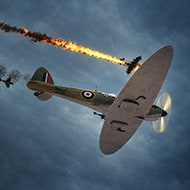
What do you do when a Bf 109 E-4 settles onto your tail and your Spitfire Mk.I refuses to turn the way you hoped? Sky On Fire: 1940 puts that question in front of you early, and the answer is rarely a hard yank on the stick. It is a single-player flight sim set in the skies over France and Britain, designed to be approachable while still punishing careless speed management.
| Genre | Accessible WWII flight sim |
| Setting | European skies, 1940 plus a 1944 extension |
| Aircraft | 18 from the 1940 theater, 20+ with the extension |
| Mode | Single-player |
| Content | Quick missions, historical campaigns, Steam Workshop missions |
Flying the Spitfire Mk.I, Hurricane Mk.I and Bf 109 E-4 in Sky On Fire: 1940
Eighteen aircraft cover the 1940 theater, but three fighters define the first hours: the Spitfire Mk.I, the Hurricane Mk.I and the Bf 109 E-4. Historically the Spitfire out-turns its rivals, the Hurricane is a tougher and steadier gun platform, and the 109 brings cannon armament and a strong climb. The sim uses airfoil-based physics, so each plane has to be flown rather than simply pointed at a target.
Early in the game the habit to unlearn is hauling the stick back as hard as possible. A slow, dragged-out turn bleeds speed until the wing stalls and the plane drops out of the fight, which is exactly what a patient opponent wants. Learning to trade height for speed keeps your options open.
Pilots arriving from arcade combat titles usually hit this wall first. Veterans of heavier sims face a different question, because the accessible approach means the systems are lighter than what they may be used to, while newcomers get airborne and fighting within minutes.
Multicrew Control: Bombers, Gunners and the He 111 H
The multicrew system lets you take over any crew member in your aircraft, from the pilot to the bombardier and the defensive gunners. In a bomber like the He 111 H you can hand the flying to the AI and sit behind a gun, which changes the whole rhythm of a sortie. Once you step into a gunner’s seat, you stop thinking about stick and throttle and start thinking about arcs of fire.
From the fighter side the same system bites back. Large bomber formations carry defensive gunners, so a lazy approach from behind gets expensive quickly, and intercepting a formation is a different job from a dogfight. Approach angle and a patient first pass matter more than raw aggression.
Players who enjoy crew-style role-play will spend whole missions swapping seats, while pure fighter pilots can ignore the system entirely and still have a complete game waiting for them.
Quick Missions, Campaigns and Workshop Content
The sim offers several ways to play, and quick missions are the best place to start. You can set up an instant dogfight, attack ground targets or practice landings, which lets you learn how a plane behaves before a campaign punishes you for it. Landing practice sounds boring until a damaged aircraft has to come home in one piece.
Linear campaigns follow historical events and real squadrons, so the battle for France and the Battle of Britain arrive as connected stories rather than isolated scenarios. The Steam Workshop adds user-made missions and campaigns, which keeps new content arriving long after the built-in material is finished.
Mission variety goes well beyond dogfights. You can assault airfields, hit strategic objectives, or attack ship convoys with risky torpedo runs, a job that feels nothing like chasing fighters through the clouds. Those torpedo runs reward steady hands and punish anyone who rushes the approach.
Dogfight Habits That Separate Pilots From Wreckage
Flight sim players share a small vocabulary, and it applies here: keep an eye on your six, look for the bounce from height, and use boom and zoom instead of turning fights you cannot win. These habits sound like clichés until a fight goes wrong without them.
- Keep your speed up, because a diving attack from height beats a slow turning fight
- Check behind you before committing to a long pass at a target
- Fire in short bursts, since the modular damage model lets parts of an aircraft fail separately
- Practice landings in quick missions, because a damaged plane still has to get home
The modular damage model changes how fights end. A hit does not always mean an explosion; a damaged aircraft may limp away or lose control in stages, so confirming a kill takes patience. Pilots who keep shooting at a smoking target often lose track of what is behind them.
Any flight-sim regular recognizes the moment when the stick goes light just before a stall. In this game that moment arrives faster than most newcomers expect, and recovering early is a skill worth drilling.
The 1944 Extension: Fw 190 A-8, P-51D and Late-War Shifts in Sky On Fire: 1940
The 1944 extension is included and adds late-war aircraft such as the Bf 109 G-14, Fw 190 A-8 and Spitfire Mk.IX, alongside American types like the P-47D, P-51D and P-38L. Together with the 1940 roster, the sim lists more than 20 authentic aircraft. That gives two very different eras inside one package.
Historically these late-war fighters are faster and heavier than the 1940 machines, so habits that kept you alive in a Hurricane Mk.I need adjusting. By the time you reach the P-51D, fights stretch across more sky and punish the same careless turns just as hard. Switching eras is the quickest way to realize how much you learned.
Some players are surprised that a name with 1940 in it holds a whole second era, and others wish the roster went further still. The accessible approach is a trade-off, but it keeps both eras open to anyone willing to practice.
Questions Pilots Ask Before Their First Sortie
Three questions come up again and again from new pilots. The answers below name the aircraft and systems involved.
Each one affects how your first few hours go, so they are worth settling before you pick a mission.
- Which plane should a new pilot start with? The Hurricane Mk.I is a forgiving first pick because it is sturdy and steady as a gun platform. The Spitfire Mk.I rewards you once you manage speed, and the Bf 109 E-4 suits a boom and zoom style after you understand energy.
- Can I control the gunners and bombardier myself? Yes, multicrew lets you take over any crew member, including the bombardier and defensive gunners. In an He 111 H you can switch seats during a mission and even let the AI fly while you work a gun.
- Are there more missions beyond the campaigns? The Steam Workshop hosts user-made missions and campaigns, so new scenarios keep appearing. Quick missions also let you set up dogfights, ground attacks and landing practice instantly.
Sky On Fire: 1940 is at its best when a Spitfire Mk.I and a Bf 109 E-4 are circling each other and neither pilot dares to bleed speed. Add the He 111 H gunner seats, the torpedo runs against convoys and the Fw 190 A-8 waiting in the 1944 extension, and the sim keeps finding new ways to test what you have learned. Every landing you bring home intact feels earned.