























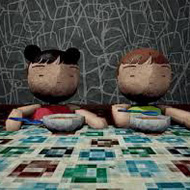
Family Secrets 1: Empty Plate











Once a player has cleared the opening phone call sequence in Family Secrets 1: Empty Plate, the actual interaction model becomes the thing worth understanding in detail, because the game asks for almost nothing in terms of inputs and gets a surprising amount of tension out of that simplicity. Movement is WASD, interaction is E, the flashlight toggles with F, and ESC brings up the pause menu. That is the entire control scheme, and the game never asks the player to learn anything beyond it.
Movement and Interaction Inside the House
Every meaningful action Miko takes in Family Secrets 1: Empty Plate funnels through the E key. Doors, objects, notes, and story triggers are all handled the same way, which keeps the interface invisible but also means the player has to physically walk up to things and look directly at them, since there is no highlight system flagging interactable objects from across a room. This forces a slower, more deliberate pace of exploration than most horror games with similar settings, where glowing prompts usually tell the player exactly where to go next.
Several players have described the early pacing as slow specifically because of this lack of guidance, and the developer has acknowledged in community discussion that movement speed and door interactions were areas they wanted to revisit. That said, the deliberate pace is also part of why later events land the way they do: when the player has spent ten or fifteen minutes simply learning the layout of the house through routine tasks, any deviation from that routine stands out immediately.
The Flashlight System in Family Secrets 1: Empty Plate
F toggles the flashlight, and it is the single tool the player has for dealing with darker rooms. There is no battery meter, no upgrade, and no secondary light source to find. Its only function is illumination, but the way it is used changes the texture of specific sequences considerably. The night sections of the house are the clearest example: with the flashlight on, the player can see exactly where they are going, which reduces tension to something manageable. Played without it, the same rooms become disorienting, and the developer has openly said in community discussion that the first night section in particular is intended to feel more unsettling without the light on, since the player loses the easy spatial reference the beam normally provides.
This creates an interesting split in how the game is actually experienced. Players who treat the flashlight as a default tool get a more conventional, navigable horror experience. Players who deliberately limit its use, especially during the night sections, tend to describe the same stretches of the game as considerably more frightening, even though nothing about the underlying triggers or events changes. The tool itself is simple, but the decision of when to rely on it functions almost like an unofficial difficulty setting that the game never states outright.
One frequently noted detail is that the flashlight tutorial does not do much to explain this trade-off, so most players only discover the darker, scarier version of the night sections by accident or after reading other players’ impressions.
No Combat, No Inventory, No Crafting
It is worth being explicit about what Family Secrets 1: Empty Plate does not include, because the absence is intentional rather than a missing feature. There is no inventory screen to manage, no items to craft, no weapons to equip, and no enemy AI to fight or evade in the traditional sense. The interaction model exists purely to support exploration and story triggers tied to specific rooms and objects, including the electrical company letter that signals the family’s worsening financial situation and the bedtime book sequence shared between Miko and Jun.
Story Triggers Tied to Specific Rooms
Because there is no quest log or objective marker, progress in Family Secrets 1: Empty Plate comes entirely from triggering the next scripted beat by being in the right room at the right point in the story. The bedroom shared by the two siblings is one of the more significant locations, hosting both the reading sequence and later, quieter moments between them. The hide-and-seek sequence is another room-dependent trigger that several players cite as a turning point, since it reuses the same controls as every other interaction but reframes them into something closer to dread than routine.
This room-by-room structure means there is effectively no way to sequence-break the story or skip ahead, which keeps the pacing consistent for every player but also means getting stuck on understanding what a specific room wants from you, particularly during darker sections, is one of the more common points of player confusion.
Why does the flashlight not have a battery or upgrade?
The flashlight in Family Secrets 1: Empty Plate is a fixed tool with a single function rather than a resource to manage, which keeps the focus on the story and atmosphere instead of survival mechanics. There is nothing to find or upgrade related to it anywhere in the house.
What do the E and F keys actually do in Family Secrets 1: Empty Plate?
E handles all object and story interactions, from opening doors to triggering scripted events, while F simply toggles the flashlight on and off. There is no separate action key for anything else in the game.
Does playing without the flashlight change the story?
It does not change story outcomes, but it changes how the night sections feel to play, since the developer has indicated the early night sequences in particular were designed to be more unsettling without the light on.
The interaction system in Family Secrets 1: Empty Plate is deliberately minimal, but that minimalism is what lets the flashlight, the locked-down E-key interactions, and the room-based story triggers carry the entire experience without ever needing a combat system or an inventory to justify their presence.