






















Absurd Trolley Problem











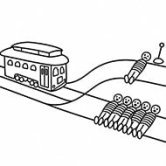
You step up to a single lever with a trolley already rolling toward five workers, and you have a few seconds to decide whether to pull it. That is the opening move of Absurd Trolley Problem, and it is the last scenario that behaves like the textbook version. By the time you reach the later scenarios, the philosophy classroom has quietly left the building.
| Genre | Moral dilemma, short scenarios |
| Number of scenarios | 30 |
| Platform | Web browser |
| Controls | Mouse or tap on the lever |
| Session length | One short sitting |
How the Lever Decision Works in Absurd Trolley Problem
Every scenario in this game boils down to one input: pull the lever or leave it alone. The trolley follows its track, whoever stands on that track reacts, and the result plays out on screen. With 30 scenarios in total, a full playthrough fits comfortably into a single short sitting.
Pulling the lever sends the trolley onto the side track, while doing nothing keeps it on its original path. That sounds trivial, but it means inaction is a real choice rather than a failure state, and the scenarios are written with that in mind. Players who arrive expecting a score or a fail screen usually adjust within the first few scenarios, because nothing here is graded the way a puzzle would be.
The lever is the entire interface, and the game never gives you a second button to hide behind.
What Beginners Get Wrong About the Lever
Most newcomers treat each scenario as arithmetic and count the people on each track. That works for the classic five-versus-one setup, then collapses as soon as the numbers stop being the point. Absurd Trolley Problem keeps building situations where the bigger group is not the obvious one to save, and counting becomes a habit the scenarios enjoy punishing.
Rushing is the second early mistake. The punchline of a scenario often sits in a small detail on the track, such as who is standing there and how they are drawn, and players who yank the lever on reflex miss the joke entirely. Two extra seconds of looking at the scene changes how many scenarios actually land.
Casual players who just want a laugh tend to pull the lever every single time to see what happens. That is a fair way to play, but it skips the scenarios where leaving the lever alone is the funnier answer.
When the Tracks Stop Making Sense
Difficulty here has nothing to do with reflexes. It is about how quickly a scenario stops resembling anything you could reason about. The early scenarios keep the classic structure, the middle stretch attaches strange conditions to whoever is on the tracks, and the later ones treat the lever as a prop in a bigger joke.
- Scenarios that change who is on the track, so the choice becomes personal instead of numerical
- Scenarios that change what the lever actually does, so the obvious pull no longer means what you think
- Scenarios that comment on the dilemma itself and poke fun at how people argue about it
Once the scenarios start commenting on the trolley problem itself, you notice the game cares less about your answer than about your hesitation. That moment of hesitation is what most players remember afterwards.
Philosophy students tend to enjoy this stretch most, since each twist reads like a counterexample to a position they have defended in a seminar.
Choosing Without a Right Answer in Absurd Trolley Problem
This is where the game gets divisive. Some players love that no choice is marked correct, while others find the lack of consequence frustrating because the scenario simply ends and the next one loads. If you wanted a branching story where earlier lever pulls reshape later scenarios, this is not that.
Community discussion splits along the same line. One camp treats the 30 scenarios as a party game, played with friends who argue loudly over every pull. The other camp plays alone and quietly stops caring around the middle, when the jokes begin to repeat their own structure.
One detail that sticks after a session is the small pause right after you commit to the lever, when the trolley is already moving and the decision can no longer be taken back. That beat of dread is the most reliable thing the scenarios do.
Reading the Setup Before You Pull
The advanced habit is to decide on a rule before you start. Some players commit to always pulling, some to never pulling, and some to a consistent principle. Rule-based runs get interesting fast, because several scenarios are built specifically to break whichever rule you picked.
A never-pull run has its own trap. Players who optimize for staying out of it discover that the trolley eventually arrives at a scenario where doing nothing is the joke, and the track you refused to touch becomes the punchline.
Comparing answers with someone else after the last scenario is the best way to use the game. Two people with different rules rarely agree on more than a handful of the 30.
Questions About Absurd Trolley Problem Answered
How many scenarios are there?
There are 30, played back to back. Each one adds a twist to the lever, the tracks, and whoever the trolley is heading toward, so a complete run is short enough that many players go again with a different rule.
Is there a correct choice at the lever?
No. Neither pulling nor leaving the lever is scored as right or wrong, which is exactly why players argue about the scenarios afterwards. Treat each one as a prompt for your own reasoning rather than a test with a hidden answer key.
What happens if you never pull the lever?
The trolley stays on its original track and the scenario resolves on its own. Leaving the lever alone is a legitimate approach, and several scenarios are written to make that choice feel funny or uncomfortable instead of safe.
Absurd Trolley Problem works because the lever never changes while everything around the trolley does. Whether you pull every time, never pull, or decide track by track, the scenarios keep forcing you to explain your reasoning out loud.