




















Don’t Drain The Lake













Don’t Drain The Lake sounds like a warning label, yet it plays like a calm, oddly satisfying job: you inherit a lakeside cabin, ignore the advice scribbled for you, and start shifting a reservoir over a dam one scoop at a time. The scale is the hook, because half a million cubic metres of simulated water have to go somewhere, and the game treats that volume seriously instead of hiding it behind a percentage.
| Perspective | First person, single-player |
| Mood | Cozy, atmospheric and mildly mysterious |
| Task | Move the water of Hollow Creek Reservoir past the dam |
| Equipment | Bucket, pumps, a siphon and a breach in Grandpa’s dam |
| Between jobs | Fishing, stone skipping and exploring the valley |
| Runtime | A single sitting with two possible endings |
Inheriting Hollow Creek Reservoir in Don’t Drain The Lake
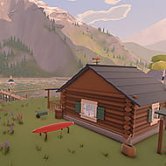
Your late grandfather’s cabin sits on the shore of Hollow Creek Reservoir, and a message he left behind begs you to keep the water exactly where it is. Practical pressure pushes the other way. A bank expects payment before the first frost, and a mill further down the valley pays a dollar for each cubic metre you release over the dam. Out in the middle of the reservoir stands a bell tower that has no business being there, which is the first sign that the story is about more than money.
New players often expect a counter to chase, so it surprises them that nothing on screen reports a percentage. You judge progress by the shoreline, the sky and the pumps themselves, and that makes the opening hours feel closer to a chore you slowly get good at than to a numbers race.
Early in the game the bucket feels laughably small next to the water it faces. The demo covers that opening stretch: the bucket, the hand pumps and your first proper pumps, ending once the surface has dropped by about a metre and a half. Incremental veterans will recognise the growth curve at once, while cozy-game fans can simply enjoy the scooping rhythm.
From Bucket to Siphon: Lifting Water Over the Dam
Pumps push water up and across the dam, but as the surface falls they must lift it higher, so each machine loses effectiveness over time. Placement is entirely your decision, and a spot that works well on a full reservoir can become a poor one a few metres lower. You are always planning for the next stretch of the drain, not the one you are standing in.
- Chaining pumps one after another so each hands the water to the next.
- Grouping several pumps on a shared manifold.
- Starting a siphon by filling it with lake water from your bucket.
- Carving a gap into Grandpa’s dam wall.
The siphon is where the game quietly rewards your patience. The bucket you began with, the one that felt pointless, returns as the thing that gets a far bigger flow started. By the time you reach the gap in the dam wall, the early hand pumps feel like they belong to a different evening.
The puzzle is mild and forgiving by design. Players who want a punishing optimisation challenge may find it too relaxed, but anyone who enjoys finding a good placement and watching it work will feel right at home.
Time of Day Tied to Water Level
The sky does the job a progress bar would do elsewhere. A full reservoir means early morning with mist hanging over the surface, the daylight shifts as the level drops, and somewhere near the bottom the valley is dark. Music, light and weather all follow the water downward, so the mood of a session changes without you ever touching a menu.
Small details sell the effect. Wind gusts can be seen sweeping across the surface before they reach you, rain taps against the pumps, and crows and gulls stroll over mud that was underwater a few minutes earlier. Players who like quiet, atmospheric games often name this stretch as the reason they keep draining.
The reservoir also stops being a single body of water. A reed bay, a flooded quarry and a whole arm of the valley end up isolated by ridges of ground, each turning into its own pond. The shape of the puzzle shifts with the water, and Grandpa’s chalk slate keeps a mark for every metre you have gone down.
Lakebed Finds and the Things Grandpa Left Behind
More than fifty objects wait on the lakebed, and bottled messages from Grandpa appear a little deeper each time you go lower. The valley hides spots nobody points out: a grotto lit by candles, a rope swing, a pickup truck overgrown by a birch tree, and a lookout with an old telescope aimed at the bell tower, close enough to see its roof slates.
Back at the cabin, Grandpa’s clock still ticks and his radio still plays. The detail only walkers notice is the static, which grows rougher the further you stray from the cabin. It is a small touch, yet it makes the valley feel lived in rather than staged.
A voice in your head comments on the drain, and Settings lets you swap between the original voice and a second one. The developers also state that the voices, music and sound effects came from AI audio tools and were then edited and mixed, that the 3D world was made with an AI coding assistant, and that nothing is generated during play. That will matter to some players more than others, so it is worth knowing in advance.
Fishing Orders From the Mill’s Cook in Don’t Drain The Lake
When the pumps are running, Grandpa’s rod waits at the end of the pier. Some fish are easy dinner, while others put up a fight that tests your timing: you give the line room, reel when it tires and try to avoid snapping it. There are six kinds of catch, from a modest perch up to the legendary fish Grandpa vouched for.
The mill’s cook sends requests for specific fish and pays a bonus when you deliver, which links the pier back to the bank’s deadline. The demo even stacks the odds in your favour at first, since your very first catch is always Rare or better and the opening casts are luckier than normal. It is a kind way to learn the reeling rhythm before a bigger fish arrives.
Stone skipping is the other pastime, and Grandpa’s record of eleven skips is carved into the bench at the end of the pier. You can also hop across the old ferry pilings or just settle into the rocking chair and watch the reservoir sink without lifting a finger.
Before You Start Draining: Answers on Don’t Drain The Lake
Is Don’t Drain The Lake just an idle clicker?
No, because you place every pump by hand and the water behaves like real water. The bucket, the pumps and the siphon each change how the drain feels, and the sky shifts as the level falls. You are solving a small hydraulic puzzle rather than waiting on a number.
How long is Don’t Drain The Lake?
It is designed to be finished in a single evening, with two possible endings. The sun’s position as Hollow Creek Reservoir drops gives you a natural sense of how far along you are, and the slate in the cabin marks each metre you pass.
What does Grandpa’s warning actually mean?
His message asks you not to drain the reservoir, and the story is about why he asked. One of the two endings is the one he hoped you would never see, and the bell tower in the middle of the water is a clue worth watching as the level falls.
Don’t Drain The Lake turns a forbidden chore into a slow, absorbing evening: a bucket that grows into pumps, a siphon that finally gets the flow going, and a bell tower that looks stranger with every metre the sun crosses. By the time the static on Grandpa’s radio is at its roughest, you will know whether you wanted the answer to his warning.