











No Blink Allowed









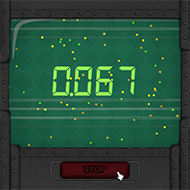
You're staring at a spinning circle, thumb hovering, waiting for the exact instant the clock reads all zeroes. You tap half a beat too early, the numbers land on 0.0421, and No Blink Allowed quietly resets you for another attempt at a target that looked easy from the outside.
| Genre | Timing, incremental |
| Core Loop | Stop the clock near zero, earn shards, upgrade |
| Session Length | Short, built for repeat attempts |
| Best For | Players who like precise, twitch-based timing challenges |
Stopping the Clock at Zero in No Blink Allowed
The entire premise is one motion: watch a circle sweep toward zero and tap at the moment you think it's closest. Land close enough and you're rewarded with shards; land far off and the run barely counts for anything.
Beginners consistently tap on instinct the first few tries, treating it like a reaction test rather than a rhythm to learn. What actually works is watching the sweep for a beat or two before committing, since the circle's pace is more readable than it first appears once you stop panicking about the number itself.
By your tenth or so attempt, the difference between a beginner and someone who's spent real time with the game becomes obvious. The beginner is still guessing, while the practiced player is reading the sweep's rhythm instead of the digits.
Shards, and What They're Actually Worth in No Blink Allowed
Shards: the currency every close stop earns you, spent afterward on a skill tree that gradually makes future stops more forgiving or more rewarding. A single great stop can be worth more shards than several mediocre ones combined, which is the entire reason precision matters more than volume.
New players tend to grind out lots of average attempts instead of chasing fewer excellent ones. That's a slower path to unlocking anything meaningful on the tree.
Community discussion around shards keeps circling back to one complaint players describe bluntly as going all in being busted. Committing everything into a single high-risk stop a handful of times can unlock more than a much longer session of cautious play.
The Skill Tree's Early Snowball Problem
Once a few nodes are unlocked, later stops start compounding faster than early ones did, and that snowball is satisfying right up until it starts feeling less like skill and more like a shortcut. Committed players who found the fastest unlock path have said as much directly in comments on the build.
It's a fair criticism and one the game hasn't fully resolved. A system built around precision timing loses some of its tension once a handful of aggressive early stops can trivialize the grind that was supposed to be the whole point.
Even so, most players who raise the complaint still come back for more attempts, since the core act of chasing 0.0000 stays compelling independent of how the tree scales around it.
Rewinding Time, Shrinking Circles, and Other Hazards in No Blink Allowed
Later stops introduce hazards layered directly onto the base loop: the clock can rewind mid-sweep, the target circle can shrink without warning, and the whole screen can slip into slow motion right as you're about to commit to a tap.
Each hazard demands a different read. A rewind means recalculating your timing mid-motion instead of trusting your first instinct, while a shrinking circle punishes players who were tracking the old, larger target instead of adjusting on the fly.
Slow motion is the one players mention most. It distorts your sense of how fast the sweep is actually moving and makes an easy stop feel deceptively difficult for a few seconds.
The Hidden End Digit and Reading the Circle Helper
Some stops obscure the final digit of the countdown entirely, forcing you to commit based on feel rather than watching the number tick down to confirm your read. It's one of the more talked-about design choices, since it removes the safety net beginners lean on most.
The circle helper is supposed to make this easier. A chunk of players have flagged confusion around it stopping near the nine o'clock position rather than exactly where expected, which makes trusting it fully a little risky until you've learned its quirks.
Players who've adjusted tend to treat the helper as a rough guide rather than a precise indicator. They split attention between it and the raw sweep instead of relying on either alone.
Glitching Displays and Chaotic Multi-Stops
The most chaotic hazard scrambles the display itself, throwing distorted digits and flickering visuals across the screen right when precision matters most. Multi-stop sequences stack several of these effects back to back, turning a single tap into a short gauntlet.
These sequences are where the game's personality really shows, since they're clearly built to be a little disorienting on purpose rather than an accident of scope. Players who clear one cleanly tend to screenshot it, which says something about how rare a clean multi-stop run actually feels.
It's also where the criticism about jitter comes up most. A few players have described input feeling slightly delayed from what's shown on screen during the busiest sequences, enough to throw off a stop that should have landed.
The Motion Sickness Complaint Players Keep Raising
Not every criticism is about difficulty. A recurring comment from players is that the background movement behind the circle makes them queasy after several minutes, which is a real and fairly common reaction rather than an exaggeration.
That's a legitimate downside worth naming plainly rather than glossing over. It affects how long some players can comfortably sit with the game in one sitting, regardless of how much they enjoy the timing challenge itself.
Players who push through it tend to take short breaks between attempts rather than chaining dozens of runs together. That seems to help more than pushing straight through the discomfort.
Why Repetition Becomes the Real Opponent
The format is short by design, and that's mostly a strength. A few players have raised a fair concern that the loop could grow repetitive if it expands into a longer release without meaningfully new hazards.
For now, that repetition is offset by how quickly a session ends and how easy it is to start another. A bad stop costs seconds rather than minutes of progress.
No Blink Allowed ultimately succeeds because it never pretends the clock is the real challenge. The real challenge is your own certainty in the half-second before you tap, and whether you trust that half-second more than the rewind, the shrink, or the hidden digit trying to talk you out of it.