

















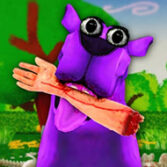
Pepper the Giant Purple Dog








In Pepper the Giant Purple Dog, you start with nothing but empty streets, a handful of scattered kibble pieces, and a dog roughly the size of a delivery truck who does not understand the concept of a sidewalk. That mismatch between a cozy premise and a genuinely heavy, momentum-driven body is the whole game in miniature. You are not steering a cute mascot so much as managing a slow-building freight train that happens to bark.
Pepper the Giant Purple Dog and the Weight Behind Every Jump
The core loop is simple to describe and harder to execute cleanly. You move left and right with A and D or the arrow keys, jump with Space, and stomp with Down, and every one of those inputs feels different depending on how much speed Pepper has already built up. Standing still and jumping produces a short, almost timid hop. Jumping mid-sprint sends Pepper into a much wider arc that clears rooftops a stationary jump never could. New players tend to treat the controls like a standard platformer, tapping jump reactively, and the game punishes that habit constantly because Pepper’s weight means every action has a wind-up and a follow-through.
The stomp is the mechanic players talk about most. It is not just a ground-pound for style points; it is how you clear certain town obstacles and how you rack up the bulk of your score once you understand the timing window. Landing a stomp slightly before Pepper’s feet actually touch the ground gives a cleaner bounce back into motion than waiting for the full landing animation to finish.
Reading Buttonvale Before You Stomp
Buttonvale is a small town, but it is dense with the kind of background detail players notice on a second or third run rather than the first. NPCs react to Pepper’s approach with genuine alarm animations before settling into forced politeness, and that half-second of panic is the one detail you only really catch once you already know where to look, since your first run is usually too busy managing movement to notice the townsfolk at all.
Learning the layout matters because giant kibble does not spawn randomly across the whole map. It clusters near rooftops and around the edges of town squares, which means routing decisions early in a run shape how much you can collect later without backtracking.
Kibble Routes and Momentum Building
- Grab kibble along a straight run rather than doubling back, since backtracking bleeds the momentum you need for rooftop jumps
- Treat early kibble clusters as speed-building opportunities, not just points
- Save stomps for moments right before a jump, since a stomp resets vertical momentum cleanly
Once you reach the rooftop sections, the game stops being forgiving about wasted movement. A run that wandered casually through the first minute usually cannot carry enough speed to clear the wider gaps later, which is the main reason score runs live or die in the opening thirty seconds.
Rooftop Timing for Pepper the Giant Purple Dog
Rooftops are where the heavy-landing physics stop being a quirk and start being the entire challenge. Pepper does not glide between roofs; the landing has real weight, and misjudging a gap by even a little sends you sliding off the edge rather than stumbling safely back onto it. Casual players and speed-focused players approach this section completely differently: casual players tend to slow down and take single jumps roof by roof, while speed-focused players chain stomp-into-jump inputs to keep momentum high across three or four rooftops in a row.
Score-chasers, meanwhile, treat rooftops as the fastest way to string together a long combo without touching the ground at all, since ground contact between jumps resets part of the combo timer.
Where New Runs Fall Apart
The most common failure point is not falling off a rooftop. It is running out of usable kibble before reaching the next cluster because an earlier route choice wasted collectibles that were only reachable from one direction. By the time you reach the second town square, a poorly planned early route has usually already cost you enough kibble that the run’s score ceiling is set, even if the rest of the platforming goes perfectly.
The heavy landing feel is also something players openly disagree about. Some find it the game’s best joke, since a giant dog should not move like a nimble platforming hero. Others find the deliberate sluggishness frustrating during precision jumps, and that split shows up constantly in comment sections under gameplay clips.
Advanced Stomp Chains and Score Pushing
Once basic movement feels natural, the next skill layer is chaining stomps directly into jumps without a pause between them. Doing this consistently keeps Pepper’s momentum from resetting and is the single biggest difference between an average run and a genuinely high score. Pausing with P to plan a tricky rooftop sequence before committing is a legitimate strategy many high-score players use rather than something only beginners rely on.
Sound cues also matter more than they first appear to. Toggling sound off with M is common among players optimizing purely for reaction time, since removing the audio layer lets them focus entirely on landing timing during rooftop chains.
- How do you stomp in Pepper the Giant Purple Dog? Press Down while airborne or right at landing; timing the press just before Pepper’s feet touch the ground produces a cleaner bounce that preserves momentum for the next jump.
- What are the controls for Pepper the Giant Purple Dog? Movement uses A and D or the arrow keys, Space handles jumping, Down triggers the stomp, M toggles sound, and P pauses the run at any point.
- How do you get a higher score in Pepper the Giant Purple Dog? Prioritize straight kibble routes early, avoid touching the ground between rooftop jumps, and chain stomps into jumps rather than pausing after each landing.
Pepper the Giant Purple Dog rewards players who stop fighting the weight and start using it, and that shift usually happens somewhere around the first rooftop stretch in Buttonvale, once the stomp-into-jump rhythm finally clicks.